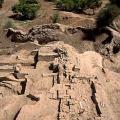
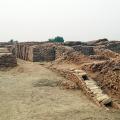
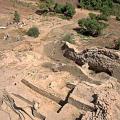
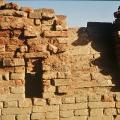
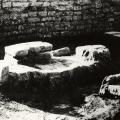
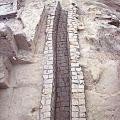
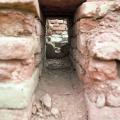
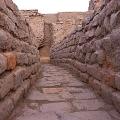
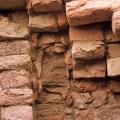
Overview of the north-south oriented brick wall (Feature 50) and doorway of the large Harappan building in Trench 39N. Note the earlier drain that runs east-west underneath the wall. >
A water management system using storm water drainage. The storm water drain in the picture is located in the citadel and connected to an arterial one on the south of the Citadel. >
A portion of a large brick drain (Feature 8) was discovered beneath the Harappan wall (see Image 63). This drain runs E-W and would probably have emptied into a larger N-S drain that flowed to the North through a now-missing gateway. >
Published in ARASI 1924-25, Plate XXIV (b). Title: Harappa: Mound F, A burial structure resembling a modern samadhi unearthed in Trench A (E) Describing the finds of this burial structure Daya Ram Sahni noted: "My excavations at Harappa … >
Brick robbing from both directions removed all but the central portion of this drain, but the remaining contents provide an important sequence of Harappan pottery spanning at least 200 years from 2400-2200 BC. >
Close-up view of ground floor drain outlet from the street side, showing a brick on edge with a notch was placed across the drain hole to keep objects from flowing out with the bath water. >
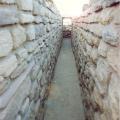
This view along Drain [8] into the mound shows details of the brick construction, the robbed out area at the east end of the drain (background), sloping strata above indicating the existence of an open street drain along the same line as the earlier… >
Many drains from upper buildings were directed to the street through enclosed channels or terracotta pipes. The pipes were made using multiple telescoping segments that fit snugly with the next segment. >