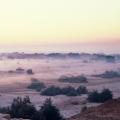
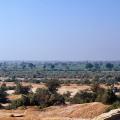
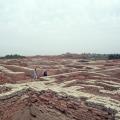
On an early winter morning the mist settles in the low-lying areas of Mohenjo daro between the "citadel" and the "lower town". In the distance the heavy mist on the Indus River forms a solid white line. The mounds of the "lower town" are barely visi… >
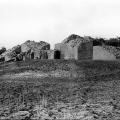
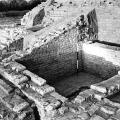
ACC - Citadel Gateway Southeast Overview of excavated remains of the so-called city wall and gateway at the southeast edge of the citadel mound at Mohenjo-daro. This structure was interpreted as a postern gate, with associated rooms and massive f… >
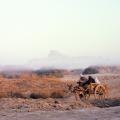
Local villagers cross the site in a donkey cart in the early morning mist, with the Buddhist stupa perched on top of the "citadel" mound. The modern road winds through the low-lying area between the "citadel" and "lower town." >
ACC - Citadel Gateway Southeast Room associated with the massive fired brick walls at the southeastern corner of the Citadel Mound. Wheeler identified this structure as a fortification wall and postern gate. No. 110 also 1114… >
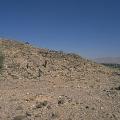
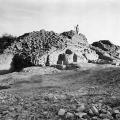
The eroded edges of the "citadel" mounds are covered with red brick dust and pottery, with traces of lighter mud brick revealing the underlying platforms that form the foundations of the uppermost buildings. This mound is encircled by a massive mud-… >
ACC - Citadel Gateway Southeast Excavations of the gateway area viewed from the southeast, looking northwest. The brick walls and rooms have been fully exposed. See slide 26Q for a view from the north. No. 112 >
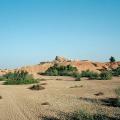
West of the "citadel" mound are lush farmlands watered by modern irrigation channels. A levee protecting the site from annual floods divides the irrigated land from the salt encrusted sediments surrounding the ancient site. The high salinity of the … >
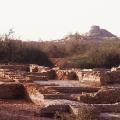
A view of the houses and streets in VS area, with the citadel and stupa mound in the background. The tops of eroding buildings have been capped with a protective layer of mud brick that will help to soak up the efflorescent salts and protect the und… >
This general view of houses in HR area shows the color of the brick walls prior to use of mud brick and clay slurry for conservation. The lower parts of the walls have the natural reddish color of fired brick. >