Home

Main navigation

  • home
  • slides
  • essays
  • articles
  • books
  • video
  • q & a
  • blog
Secondary menu
  • about us
    • scholars
    • privacy
    • support
    • image rights
    • credits
    • contact us
  • resources

Chert

Chert related objects and activities related to the ancient Indus Civilization.

Late Palaeolithic workshop

Around the Tomb of Adam Sultan many late Paleolithic workshops were found. Some were of impressive diameter. The most characteristic tools are subpyramidal bladelet cores. The sites are attributed to the Late (Upper) Paleolithic period on the basis … >

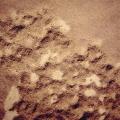
Aerial View

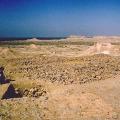
One of the main minig areas from an altitide of 80 metres. The quarry pits are lighter, semi-circular spots which show areas where sand blown from the neighbouring Thar Desert has been trapped in the quarry depressions. >

Late Palaeolithic workshop

Ziarat Pir Shaban 2 is a Late (Upper) Palaeolithic site. It is two miles southeast of the Tomb of Ziarat Pir Shaban in the Shadee Shaheed Hills. >

Quarry Pit

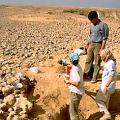
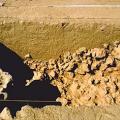
The excavation of one of these quarry pits was carried out in February 1995. The excavation took place over a small 2 by 3 meter area facing the Indus Valley. >

Late Palaeolithic Workshop

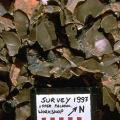
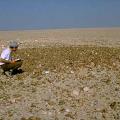
The surface of one of the late Palaeolithic workshops discovered in the survey of February 1997. One pyramidal, bladelet core is in the middle of the slide. >

Pit 862

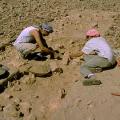
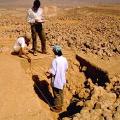
The excavation of quarry-pit 862 underway with Drs. F. Negrino (archaeologist), C. Ottomano (paleopedologist) and E. Starnini (archaeologist). >

Chert Flakes and Knives

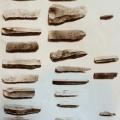
IMPLEMENTS USED BY A PREHISTORIC INDIAN PEOPLE IN THE REMAINS OF WHOSE BUILDINGS THERE IS NO TRACE OF IRON: FLAKES AND KNIVES OF CHERT FOUND DURING THE EXCAVATIONS OF THE EARLIER BUILDINGS AT MOHENJO-DARO >

Quarry Pit 862

The excavation of quarry-pit 862 (map) underway with Drs. F. Negrino (archaeologist), C. Ottomano (paleopedologist) and E. Starnini (archaeologist). >

Quarry Pit 862

Excavation of site 862 revealed that the pit had been used by Harappan miners down to a depth of 1.30 meters where the flint vein was encountered. From this pit, a radiocarbon reading of a small charcoal fragment indicated that the mine was explo… >

Pagination

  • First page
  • Previous page
  • Page 1
  • Page 2
  • Page 3
© Harappa.com 1995-2026 31