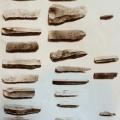
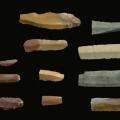
IMPLEMENTS USED BY A PREHISTORIC INDIAN PEOPLE IN THE REMAINS OF WHOSE BUILDINGS THERE IS NO TRACE OF IRON: FLAKES AND KNIVES OF CHERT FOUND DURING THE EXCAVATIONS OF THE EARLIER BUILDINGS AT MOHENJO-DARO >
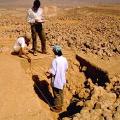
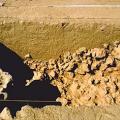
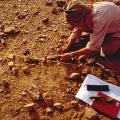
Excavation of site 862 revealed that the pit had been used by Harappan miners down to a depth of 1.30 meters where the flint vein was encountered. From this pit, a radiocarbon reading of a small charcoal fragment indicated that the mine was explo… >
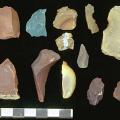
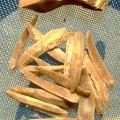
Four Harappan workshops were excavated, including site 480 from which more than 35,000 artefacts were collected. Most of them were debitage flakes, but also included narrow blades, bladelets and accurately made bullet cores. >
Some of the narrow bladelets discarded by Harappan flint-knappers are only 2-3 millimeters wide. Bladelets were later retouched into insturments in the Indus Valley cities. They were often shaped into microdrills for piercing stone and shell beads. >
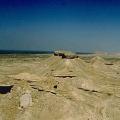
The Rohri Hills as they appear along the western fringe of the plateau, facing the fertile Indus Valley, where most of thhe Harappan flint quarries and workshops have been discovered. (The shadow is from the helicopter.) >