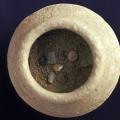
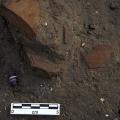
Initial probing to determine the contents of this small pot (79) from Trench 38, Late Harappan Period, revealed the presence of carnelian and faience beads. >
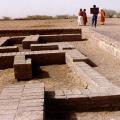
The bead factories, situated where the 8th street of the commercial area and the 5th street of the residential area meet, comprised the main industry of the Harappans. They probably settled (or their culture came) to the Gulf of Cambay region becaus… >
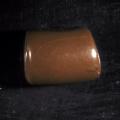
This bead was thought to be the earliest glass in the subcontinent, dating at least to 1700 BC. Trench 38, Late Harappan Period. However, subsequent analysis in 2008 has determined that it is not glass, but some form of crystalline rock. >
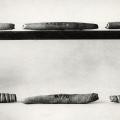
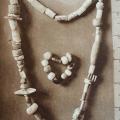
Six long beads, exhibited in two rows of three each. From mounds F and AB. Finds nos. that are noted are: A(e) 99, Ab 692, A(f) 1, B 1543, B 770. Two on either side of the bottom row are of terracotta as they look similar to the one publish… >
This collection was found from the eroding surface of Bawani, a site not far from Harappa that dates from the 3rd century BC. The red brown beads are glass beads of the Early Historic Period showing a continuity with the glazing technology of red fa… >
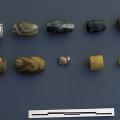
A banded agate bead (at left), a long terra cotta bead (center) and a cylindrical steatite bead (at right) were all found in the deposits of a room in Trench 54. >
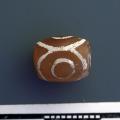
This carnelian bead has been artificially colored with white lines and circles using a special bleaching technique developed by the ancient Harappans. >
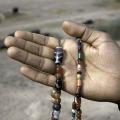
The technique for making tiny beads is still practiced by craftsmen today. Mullah Ashoor from Peshawar is seen grinding a string of tiny steatite beads that will later be fired to make them hard >