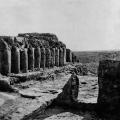
A decade later, after excavating the pre-Indus site of Amri in Sindh, Jean-Marie Casal published the book La Civilisation d l'Indus et ses enigmes [The Indus Civilization and its Puzzles] (1969). In the section Mundigak becomes …>
Jean-Marie Casal writes "Note also that, during their occupation, the first occupants of Mundigak [which he thought were nomads around 4500 BCE, but now is dated more towards 4000 BCE] already how to make use of copper, the evidence for which was th… >
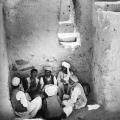
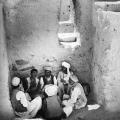
Sylvia Matheson captioned the above photograph: "Shade from the thick, mud-brick walls (which were on stone foundations) excavated in the residential quarter on Mound B provides welcomes relief from the sun's heat during the midday meal. The large o… >
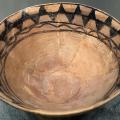
A Mundigak III (3400-2900 BCE) bowl. J.F. Jarrige writes in The Early Architectural Traditions of Greater Indus as Seen from Mehrgarh, Baluchistan "Work conducted at Mehrgarh has clearly shown that the cultural assemblage of the preurban phases … >
Original caption by Sylvia Matheson: Shade from the thick, mud-brick walls (which were on stone foundations) excavated in the residential quarter on Mound B provides welcomes relief from the sun's heat during the midday meal. The la…>