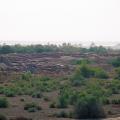
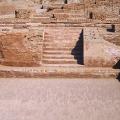
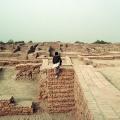
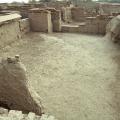
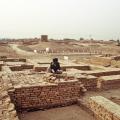
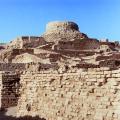
The side walls of the tank were constructed with finely fitted bricks and a thick layer of bitumen (natural tar) was laid along the sides of the tank to keep water from seeping through the walls and up into the superstructure. >
Many houses had stairs leading to upper courtyards of the building or to a second floor. This house in HR area had a double staircase that would allow people to enter and exit the upper courtyard in an orderly fashion. Some scholars feel this may ha… >
This large room or courtyard was filled with a solid mud brick platform that was almost entirely excavated to investigate the underlying room. A section of the platform has been preserved beneath the tin roof on the left and part of the platform is … >
The UM excavations conducted by Dr. G. F. Dales in 1964-65 exposed a massive mud brick platform that was used to raise a group of brick buildings several meters above the street level which was seen in the foreground. The street was approximately se… >
Mackay writes that most of the bosses on the backs of seals had the same size and shape. The perforation always runs in the direction of the animal's body, to help keep the seal upright when worn around the neck. The boss is centered on the back … >
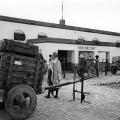
Museum Campus Traditional Sindhi oxcarts were used to transport crates of pottery and artifacts to Dokri Train station where they were loaded onto a train for transport to Karachi or Lahore. No.77 >
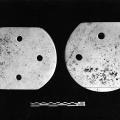
Area not known Perforated stone objects. The precise function of these stone objects is not known, but they may have been used to hold wooden beams that were held in place with three small dowels. They may have been used as a locking mechanism or… >