Home

Main navigation

  • home
  • slides
  • essays
  • articles
  • books
  • video
  • q & a
  • blog
Secondary menu
  • about us
    • scholars
    • privacy
    • support
    • image rights
    • credits
    • contact us
  • resources

Slides by Richard H. Meadow, Project Director of HARP (Harappa Archaeological Research Project). His excavations focus on the ancient Indus Valley sites in Pakistan including Balakot near Karachi, Mehrgarh in Baluchistan, and Harappa since 1995.

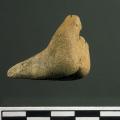
Early Harappan stylized female figurine from Harappa

The earliest anthropomorphic figurines from Harappa thus far are from the Early Harappan (Ravi Phase, Period 1, and Kot Diji Phase, Period 2) levels. Among these are stylized seated female figurines with exaggerated buttocks and thighs and joined le… >

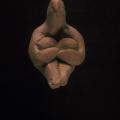
Seated male figurine from Harappa

Seated male figurines may have their knees drawn up tightly to their chests. While some have facial features and headbands and/or hair, many have featureless faces and no ornamentation. Approximate dimensions (W x H x D): 3.6 x 4.9 x 3.0 cm. >

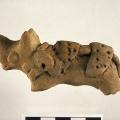
Rhinoceros figurine from Harappa

Although it was surely a wild animal, some of the rhinoceros figurines wear collars. While a collar might indicate domestication, it is unlikely that this is the case with the rhinoceros, although they may have been held as captives. Approximate … >

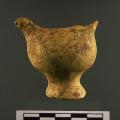
Bird figurine/whistle from Harappa

Other bird figurines have no wings depicted at all and either stand on a circular base or on two legs that were inserted into the base of the body (only holes remain). Still others have no legs depicted at all. Among the most convincing cases for fi… >

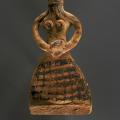
Early Harappan female figurine with painted features from Harappa

Another style of Early Harappan female figurine holds a round object, possibly a vessel, with both hands at the waist above a flaring lower body which ends in a (broken) forward-extending base. The hair is bound at the back of the head into a tiered… >

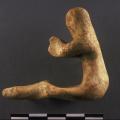
Seated male figurine with hands raised from Harappa

Another type of male figurine sits with legs extended straight in front of the body and arms raised in front of the chest with hands clasped together, probably a posture of devotion or prayer. Approximate dimensions (W x H x D): 2.9 x 5.1 x 5.8 … >

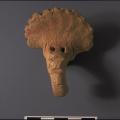
Elephant figurine head with painted designs from Harappa

It is unknown whether elephants were domesticated in the Indus Civilization. However, one of the few elephant figurines from Harappa is a head with large stylized ears and red and white stripes painted across the face. This may mirror the custom of … >

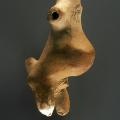
Animal "puppet" figurine from Harappa

Some terracotta figurines such as the unusual ithyphallic pot-bellied animal figurines with tails and holes through the shoulders for movable arms were probably used as toys or puppets. A few examples also have holes in their bases. Approximate … >

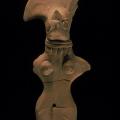
Female figurine with a fan-shaped headdress from Harappa

At the peak of the Indus Civilization or the Harappan Period (Period 3), the most common dress for female figurines was the belt and/or short skirt usually situated at the same point on the hips as the figurine’s hands. The fan-shaped headdress was … >

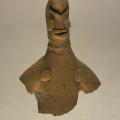
Male figurine with hair swept forward from Harappa

In addition to different postures, male figurines also exhibit a variety of hairstyles. Both male and female figurines may have hair swept around the top of the head, to the side or to the front. A few male figurines also wear a sort of "torque" cho… >

Pagination

  • First page
  • Previous page
  • Page 1
  • Page 2
  • Page 3
  • Page 4
  • Page 5
  • Page 6
  • Next page
  • Last page
© Harappa.com 1995-2026 31