Slides by Richard H. Meadow, Project Director of HARP (Harappa Archaeological Research Project). His excavations focus on the ancient Indus Valley sites in Pakistan including Balakot near Karachi, Mehrgarh in Baluchistan, and Harappa since 1995.
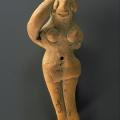
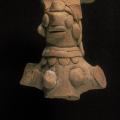
A few female figurines from Harappa have a sort of "tiara" attached to the front of the fan-shaped headdress. Approximate dimensions (W x H x D): 6.0 x 8.7 x 3.9 cm. >
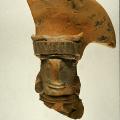
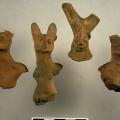
Most male figurines from Harappa do not wear headdresses. An unusual exception is a standing male figurine wearing a fan-shaped headdress usually worn by female figurines as well as a choker with pendants. This may be a representation of an alternat… >
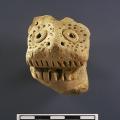
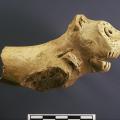
Among the dangerous wild animals represented in the figurine corpus are large wild felines. One feline figurine with punctuate designs on the face (possibly representing spots) and an open mouth showing teeth is a relatively naturalistic representat… >
The movable heads of figurines often depict cattle. They are usually pierced laterally through the neck and vertically or sagittally through the head in order to secure them to the bodies and control them with a cord. Approximate dimensions (W x… >
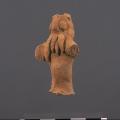
Other female figurines have a double volute headdress that is usually decorated and sometimes painted black as well. Female figurines are usually depicted standing with their legs pressed together all the way to the feet and sometimes have their han… >
Male figurines are sometimes also identified by secondary sex characteristics such as beards. Occasionally, male figurines wear a headdress with two upward and/or outward projections like horns. Similar figures with horned headdresses are found in t… >
Many of the feline figurines are depicted with collars around their necks (as with the rhinoceros). Rather than indicating that these large cats were tame, this symbol of domestication may have been used in rituals of sympathetic magic to obtain a s… >
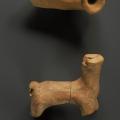
A different style of quadruped body has a vertical neck shaft for attaching and possibly changing the (separate) head. Figurine heads with this type of neck shaft include the markhor heads discussed earlier (see image #40). Approximate dimension… >
The "cones" that often decorate figurine headdresses may be reproductions of the small gold cones that have been found at Indus Civilization sites. Similar small gold cones are still used as hair ornaments in South Asia. Approximate dimensions (… >
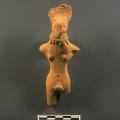
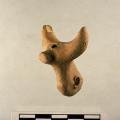
A few figurines are not clearly male or female, or even anthropomorphic or animal. One unusual recently discovered figurine has no clear sex characteristics. It does have two projections (broken off) that pointed forward from the back of the head as… >