Slides by Richard H. Meadow, Project Director of HARP (Harappa Archaeological Research Project). His excavations focus on the ancient Indus Valley sites in Pakistan including Balakot near Karachi, Mehrgarh in Baluchistan, and Harappa since 1995.
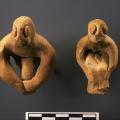
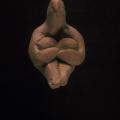
Most male figurines from Harappa sit with knees bent and arms at the sides of the legs or around the knees. Some of these figurines have facial features and even genitalia, and a few have stylized legs joined into a single projection. Approximat… >
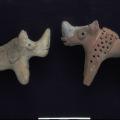
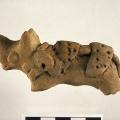
Larger wild animals such as the rhinoceros with its distinctive "horned" snout are also represented. Although the rhinoceros is no longer found in many areas of the Indus region, rhinoceros bones have been found at Harappa. Some rhinoceros figurines… >
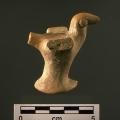
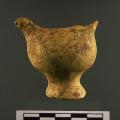
Many bird figurines have circular bases instead of legs and feet. Some have outstretched wings and may represent birds in flight. Approximate dimensions (W x H(L) x D): 4.4 x 5.4 x 5.3 cm. >
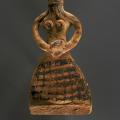
The earliest anthropomorphic figurines from Harappa thus far are from the Early Harappan (Ravi Phase, Period 1, and Kot Diji Phase, Period 2) levels. Among these are stylized seated female figurines with exaggerated buttocks and thighs and joined le… >
Seated male figurines may have their knees drawn up tightly to their chests. While some have facial features and headbands and/or hair, many have featureless faces and no ornamentation. Approximate dimensions (W x H x D): 3.6 x 4.9 x 3.0 cm. >
Although it was surely a wild animal, some of the rhinoceros figurines wear collars. While a collar might indicate domestication, it is unlikely that this is the case with the rhinoceros, although they may have been held as captives. Approximate … >
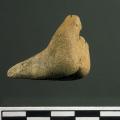
Other bird figurines have no wings depicted at all and either stand on a circular base or on two legs that were inserted into the base of the body (only holes remain). Still others have no legs depicted at all. Among the most convincing cases for fi… >
Another style of Early Harappan female figurine holds a round object, possibly a vessel, with both hands at the waist above a flaring lower body which ends in a (broken) forward-extending base. The hair is bound at the back of the head into a tiered… >
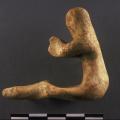
Another type of male figurine sits with legs extended straight in front of the body and arms raised in front of the chest with hands clasped together, probably a posture of devotion or prayer. Approximate dimensions (W x H x D): 2.9 x 5.1 x 5.8 … >
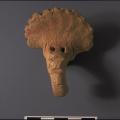
It is unknown whether elephants were domesticated in the Indus Civilization. However, one of the few elephant figurines from Harappa is a head with large stylized ears and red and white stripes painted across the face. This may mirror the custom of … >