Home

Main navigation

  • home
  • slides
  • essays
  • articles
  • books
  • video
  • q & a
  • blog
Secondary menu
  • about us
    • scholars
    • privacy
    • support
    • image rights
    • credits
    • contact us
  • resources

Omar Khan

Slides of the mounds in Harappa and other archaeological sites in the Indus Valley by Omar Khan

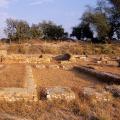
"Great Granary," Harappa

No grain, storage containers or clay sealings such as would have been attached to goods for shipment were found in the so-called "Granaries" of Harappa or Mohenjo-daro. Archaeologists today prefer to call these structures great halls, since they wer… >

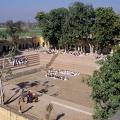
Contemporary Bath, Harappa

No "Great Bath" like that in Mohenjo-daro has been found in Harappa, and it is not known if one existed among the miles of ruins carted off for railway construction in the early 1850's. A large bath does however exist very near the mounds, construc… >

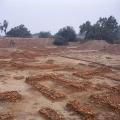
"Granary" or Mound F Rooms, Harappa

Individual rooms are 15 by 6 meters long, and have sleeper walls for airspace between them. At each end of the rooms are three raised platforms. >

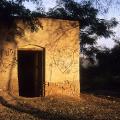
Guard hut, Harappa

Contemporary guard hut overlooking the "Granary." Many questions about ancient Harappa will never be answered. But with the first modern, multi-disciplinary excavations of an Indus city at Harappa, many misconceptions are being laid to rest and much… >

Sealing

Seals were used to make a sealing, or positive imprint, like this modern resin one made from the original seal. Sealings were used in ancient times for trade. They would be made on ceramics or the clay tags used to seal the rope around bundles of go… >

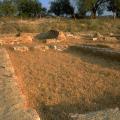
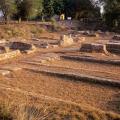
Mound F Room, Harappa

There are no answers to the purpose of this structure; current speculation suggests it may have been a palace for a ruler or a ruling group, or perhaps even a building for priests such as the later Buddhist monasteries. >

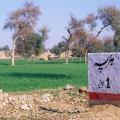
Harappa One Kilometer Roadsign

A one kilometer to Harappa road sign in Urdu with Mound AB in the distance. >

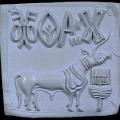
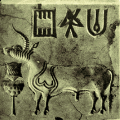
Unicorn Seal

This unicorn seal was also discovered during the late 1927-31 excavations at Mohenjo-daro. One theory holds that the bull actually has two horns, but that these have been stylized to one because of the complexity of depicting three dimensions. Howev… >

Wall, Harappa

New possibilities might be forthcoming in the next two years [as written in 1998]. Excavations are due to begin in the small parts of the granary not completely excavated by the first archaeologists at Harappa, R. B. D. R. Sahni and M.S. Vats, betwe… >

Harappa Mound AB

Building remnants on Mound AB, Harappa in the morning. >

Pagination

  • First page
  • Previous page
  • Page 1
  • Page 2
  • Page 3
  • Page 4
  • Page 5
  • Next page
  • Last page
© Harappa.com 1995-2026 31