Slides on the archaeology and excavation of ancient Indus Valley sites including Harappa by Jonathan Mark Kenoyer of the University of Wisconsin, Madison.
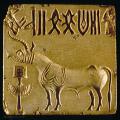
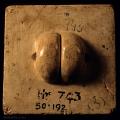
Large square unicorn seal with perforated boss on the back (26). The unicorn is the most common motif on Indus seals and appears to represent a mythical animal that Greek and Roman sources trace back to the Indian subcontinent. A relatively long … >
Large square unicorn seal (25.) with perforated boss on the back (26). The unicorn is the most common motif on Indus seals and appears to represent a mythical animal that Greek and Roman sources trace back to the Indian subcontinent. A relatively l… >
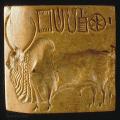
The majestic zebu bull, with its heavy dewlap and wide curving horns is perhaps the most impressive motif found on the Indus seals. Generally carved on large seals with relatively short inscriptions, the zebu motif is found almost exclusively at the… >
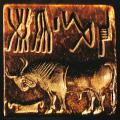
This is a flat square double sided seal. On one side, four script symbols are inscribed in reverse, above a bison with head lowered to the feeding trough. A swastika motif turning counter clockwise is carved on the reverse. The seal is perforated fr… >
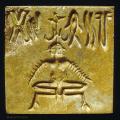
Square seal depicting a nude male deity with three faces, seated in yogic position on a throne, wearing bangles on both arms and an elaborate headdress. Five symbols of the Indus script appear on either side of the headdress which is made of two out… >
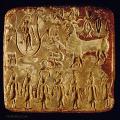
Seal depicting a deity with horned headdress and bangles on both arms, standing in a pipal (sacred fig) tree and looking down on a kneeling worshiper. A human head rests on a small stool. A giant ram and seven figures in procession complete the narr… >
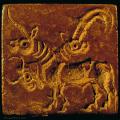
Square seal with multiple headed animal depicting three important totemic animals: the bull, the unicorn, and the antelope. All three animals are seen individually on other seals along with script, but this seal has no script. Material: gray brow… >
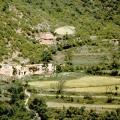
Terraced fields along the Margalla hills north of Islamabad, represent the adaptive strategy of agriculture in different parts of the greater Indus Valley. Similar agricultural villages were established by Indus settlers in Baluchistan and the north… >
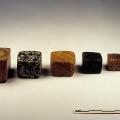
Cubical weights in graduated sizes.These weights conform to the standard Harappan binary weight system that was used in all of the settlements. The smallest weight in this series is 0.856 grams and the most common weight is approximately 13.7 grams,… >
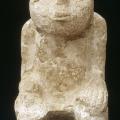
Seated male sculpture with shell inlay still remaining in one eye. The braided or combed hair lays back straight and a plain fillet or ribbon encircles the head and falls down the back of the neck. Two strands of a ribbon or braided hair hang over t… >