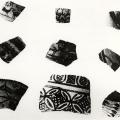
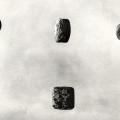
Nine sherds, painted potsherd Right, Top row: painting of a ‘Peacock and a hen facing each other’ Sahni documented this potsherd from Mound F, area of parallel walls with a copper nail extractor, several seals, a large copper chisel (Ae 342), te… >
Find nos. AF12, P IV 100, B 1705. 1. Left: broken piece of a bangle, resembles Pl CXXXVIII, no 5, Possibly of faience. Vats noted: “Most of the faience examples are ornamented with cog-wheel edges or incised linear patterns” (Vats 1940, p. 448)… >
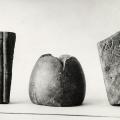
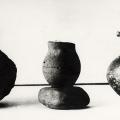
Left: Inscribed pottery Middle resembles no. 21, in Vats 1940 (Vol. II) Pl LXXXIII. Vats described this and another (no. 20) as quatrefoil cones. See Photo 54 for description of 20. “… No. 21 (PII-20) of red sandstone. This latter is the best… >
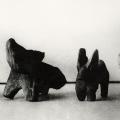
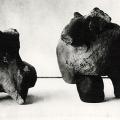
Four in a row: of them one ram and one unicorn. Vats stated: “Animal figures, mostly in terracotta, have been found in very large numbers at Harappa. … Harappa offers a greater variety of animal figures than those yet published from Mohenjo-daro… >
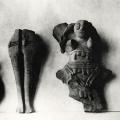
Three are female, the fourth, second from left is of the lower part of a finely modelled figure. Find no. A 127. Right: has a thick braid. Second from right: wears “a distinctive headdress which rises fan like from back of the head… a close fi… >
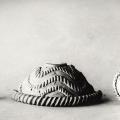
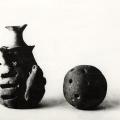
Left: Terracotta Birdcage. Find no. Ab 554. Published in Vats 1940 (Vol. II) Pl. CXX, no. 22. Middle: a round dice, or a ball, with holes on surface. Find no. 5859. Right: Double headed terracotta bust of lion on a cone. Published in ARAS…>
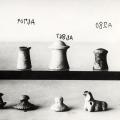
10 small objects in two rows of five each. Top row: Similar looking objects published in Vats 1940 (Vol. II), Plate CXVII, nos. 28-31. Vats described these as “chessman shaped lingams” and mentioned that they “are found in very large numbers … >