An essay by Iravatham Mahadevan in response to the studies of Asko Parpola concerning the script and writing system of the Ancient Indus Valley Civilization.
Introduction Iravatham Mahadevan is a National Fellow of the Indian Council of Historical Research, and has been working on the Indus script for over 40 years. His publications include The Indus Script: Texts, Concordance and Tables (1977). A Tamil speaker, he has used historical linguistics and statistical studies to examine the Dravidian components in Vedi… >
The Indus Squirrel Sign: Title of Murukan The 'Squirrel' Sign: Title of Murukan Fig. 3: Bangles and Squirrel Sign Parpola has proposed reading a pair of signs as 'bangles + squirrel' (Fig.III b), interpreting it as a divine title. The second sign appears to depict a small animal perched on a tree branch. Parpola has, in my opinion, … >
Fig Indus Tree + Crab Sign as Proto Rudra 'Fig Tree + Crab' Sign: Proto-Rudra Fig. 4: Fig Tree + Crab Sign and Components Parpola refers to two sets of copper tablets, both with the same inscription on one side but two different motifs on the other. One of the motifs is the 'fig tree + crab' sign (Fig.IV: Sign 124) occurring as … >
Assessment of Parpola's Model of Decipherment One can try to assess Parpola's decipherment at two levels. First, one can analyse his interpretations and readings of individual signs, some of which I have attempted above. To sum up, problems arise at this level due to implausible identification of pictorial signs, arbitrary assignment of values to non-pictorial … >
Introduction Asko Parpola needs no introduction to those interested in the problems of the Indus script. A specialist in Vedic philology, he turned his attention at an early stage in his career to the decipherment of the Indus script and has, along with his Finnish colleagues, made immensely valuable contributions to his chosen field over the last three deca…>
Asko Parpola Asko Parpola needs no introduction to those interested in the problems of the Indus script. A specialist in Vedic philology, he turned his attention at an early stage in his career to the decipherment of the Indus script and has, along with his Finnish colleagues, made immensely valuable contributions to his chosen field over the last three decades. Although he i… >
The Coming of the Aryans Parpola proposes a new theory about when, from where and how the Aryans came into the Indian sub-continent and the identity of the Dasas (Dasyus) who were their traditional enemies. According to this theory, the Rigvedic Aryans were preceded by another wave of Indo-European speaking invaders who called themselves the Dasas and who penetrated f… >
Myth of the Aryan Invasion It has often been pointed out that the complete absence of the horse among the animals so prominently featured on the Indus seals is good evidence for the Non-Aryan character of the Indus Civilization. Parpola quotes from a fairly up to date and authoritative report by Richard Meadow that there is as yet no convincing evidence for horse remains … >
Pictorial Interpretation of the Indus Signs The Indus script has about 400 signs and is mainly pictographic in character. However there are also many signs too stylised or simplified to be identified pictorially. Two main characteristics of the script are modification of signs by the addition of diacritic-like marks and combination of two or more signs into composite sign… >
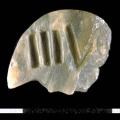
[Recently discovered token or tablet, Harappa] Structural studies of the Indus inscriptions have been carried out by a number of scholars ever since the discovery of the Indus Civilization and its writing. The most outstanding work in the earlier period is that of Hunter who provided reliable eyecopies of the inscriptions, a manually arranged sign concordance and a detailed … >