
Mohenjo-daro!
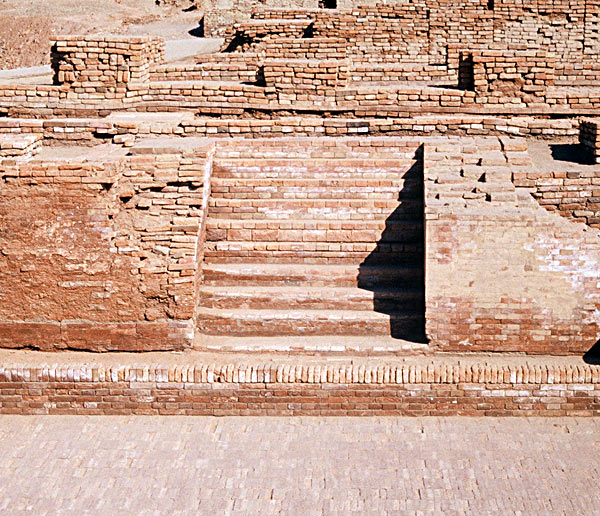
Mohenjo Daro, or "Mound of the Dead" is an ancient Indus Valley Civilization city that flourished between 2600 and 1900 BCE. The site was discovered in the 1920s and lies in Pakistan's Sindh province. Only a handful of archaeologists have excavated here, described in the introduction and illustrated essay Mohenjodaro: An Ancient Indus Valley Metropolis.
These 103 indexed images were taken over 30 years. Most have not been published before. By Jonathan Mark Kenoyer.
|
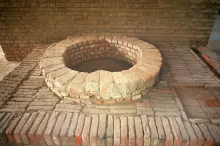
81. Pipal-leaf shaped well, Lower Town This unique well and associated bathing platform was discovered in the course of building a catchment drain around the site. It was reconstructed on the ground floor of Mohenjo-daro site museum. |
|
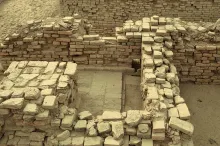
82. Bathing platform, DK-I Area This bathing platform is located next to the street, and is made with bricks laid flat. A small drain running along one side of the bathing floor channels dirty water out to the street. A brick on… |
|
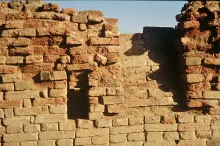
83. Drain outlets, DK-I Area The ground floor drain of the bathing platform empties out into the street next to tapered chute from a roof drain or a second storey bathing area. |
|
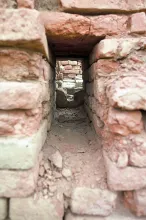
84. Rain Outlets, DK-I Area Close-up view of ground floor drain outlet from the street side, showing a brick on edge with a notch was placed across the drain hole to keep objects from flowing out with the bath water. |
|
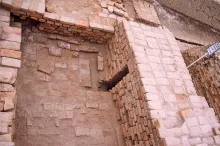
85. Bathing platform, SD Area A bathing platform in SD area with brick floor made with flat paved bricks. Many bathing platforms were made with watertight floors constructed with bricks laid on their edge. |
|
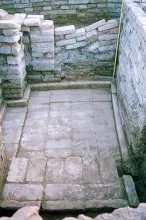
86. Bathing Platform, UM Area A bathing platform in UM area with blocked up doorway leading into the room. The brick floor was made with carefully fitted flat paved bricks and a smaller catchment drain along the side of the… |
|
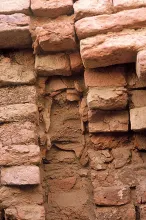
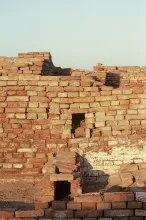
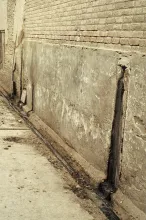
87. Terracotta Drainpipes Built into a Wall, Lower Town Many drains from upper buildings were directed to the street through enclosed channels or terracotta pipes. The pipes were made using multiple telescoping segments that fit snugly with the next… |
|
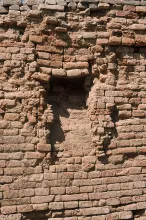
88. Covered Drains Leading from the Dyer's Workshop, VS Area A small drain leads from the well and finely fitted brick floor of the dyer's workshop to a covered drain at the edge of the street. |
|
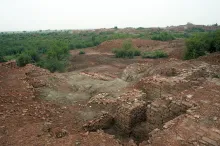
89. Drain chute, DK-G Area Many of the buildings at Mohenjo-daro had two or more stories. Water from the roof and upper storey bathrooms was carried through enclosed terracotta pipes or open chutes that emptied out onto the… |
|
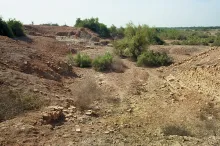
90. UM Area, and Citadel Mound The UM excavations conducted by Dr. G. F. Dales in 1964-65 exposed a massive mud brick platform on top of which were built numerous brick buildings separated by narrow lanes. The pottery excavated… |
|
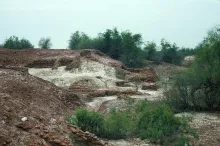
91. UM Area, Massive Mud Brick Platform and Street The UM excavations conducted by Dr. G. F. Dales in 1964-65 exposed a massive mud brick platform that was used to raise a group of brick buildings several meters above the street level which was seen… |
|
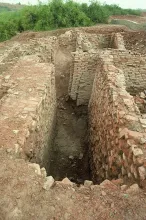
92. UM Area, Massive Mud Brick Platform and Fired Brick Sizes A large section of the mud brick platform in the UM Area was removed to be sure that it was not concealing other brick structures. The fired bricks of the upper buildings measured 7 x 15 x 29 cm … |
|
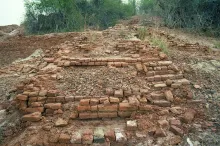
93. UM Area, Blocked Lane Empty spaces and alleyways in large cities like Mohenjo-Daro were used to dispose of trash and occasional unwanted bodies. This blocked lane in the UM excavation area had a human skeleton dumped… |
|
94. UM Area, Unexcavated Houses These rooms of a house are located at the edge of the area excavated by Dr. G. F. Dales in 1964 (UM Area). The room has a nodule floor fill and clearly defined fired brick walls. These vitrified… |
|
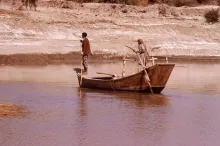
95. Ferry boat on the Indus River near Mohenjodaro Flat bottomed ferry boats are used even today to help travelers cross the Indus River near Mohenjo-daro. |
|
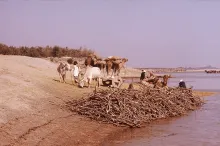
96. Camels waiting to cross the Indus River near Mohenjo-daro Although long distance travel on the Indus River is no longer feasible due to the construction of barrages and dams, local trade of firewood and other daily necessities is still moved up and down or… |
|
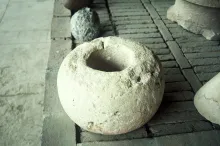
97. White Limestone Ringstone Numerous ringstones made from white limestone have been recovered from Mohenjo-daro. Sometimes several have been found together, but none are in their original position of use. Discoveries of similar… |
|
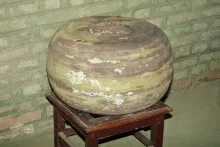
98. Banded Limestone Ringstone, Mohenjodaro This large ringstone is made of banded yellow and red-brown limestone. Sourcing studies of different varieties of limestone conducted by Randall Law, of the University of Wisconsin, Madison, suggest… |
|
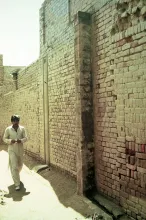
99. Modern Latrine Drain at Harappa town Latrines located inside a courtyard of modern Harappa town have drains that fall directly into the open street drain. (See Indus 1, Slide 12 for an ancient bathing platform.) |
|
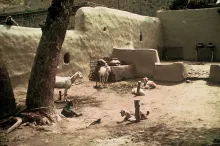
100. Modern Second Storey Drain at Harappa Town In the modern town of Harappa, a covered drain built along the outside of a house takes sewage water from a second storey latrine and bathroom to the street level drain without splashing people… |
|
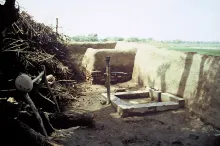
101. Modern terraced courtyard in Harappa town This courtyard of a modern house in Harappa town, has an upper level in front of the house that is plastered and has a small entryway that can be blocked to keep out animals. Drinking water is kept… |
|
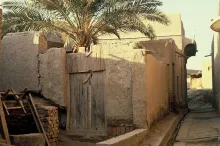
102. Bathing area and latrine in Harappa town The bathing areas and walled latrine are located on the interior edge of the courtyard that touches the street. The drain from the bathinga area runs through the wall and falls directly into the… |
|
103. Modern house with Well and Drains, Sehwan, Sindh The old part of the city of Sehwan, Sindh, is built on a high mound of the earlier buried city, much like ancient Mohenjo-daro. A neighborhood well is located alongside the street that has an open… |