
Harappa Excavations 1995-2001
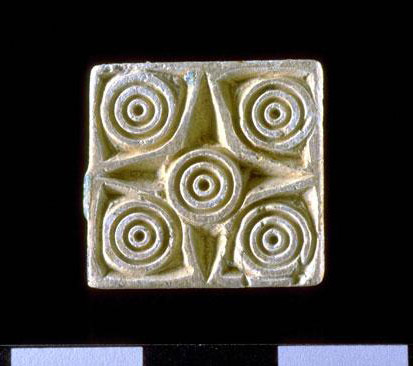
New light on the recently named Ravi Phase (3300-2800 BCE), the Kot Diji Phase (2800-2600 BCE), and the Harappa Phase (2600-1800 BCE).
|
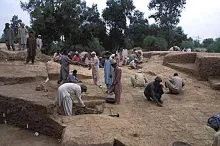
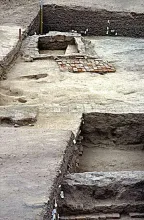
81. Mound E perimeter wall excavations In 2001, excavation of perimeter wall [250] was extended to the Northwest. Here the surface of the wall is being cleared and the bricks outlined. Note the excavation in the foreground left where… |
|
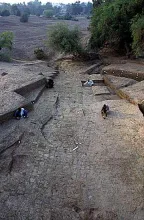
82. Mound E perimeter wall View of the preserved surface of perimeter wall [250] excavated in 2001 looking Southeast toward the area excavated from 1993 to1997. |
|
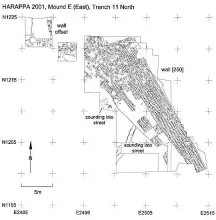
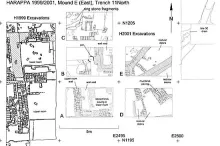
83. Plan of Mound E perimeter wall segment Plan view of the portion of perimeter wall [250] excavated in 2001. The pattern of the bricks suggests a complicated series of additions to the inside of the structure that are not yet well… |
|
84. Structures adjoining perimeter wall In the South, perimeter wall [250] was preserved to a lesser altitude than in the North. In the very south of the area excavated in 1996, the lower portions of the walls of a mud-brick room were… |
|
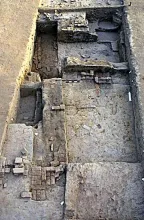
85. Structures inside perimeter wall Excavations during the 1997-2001 seasons were carried out inside perimeter wall [250]. Here a partial plan of those excavations shows superimposed levels of Period 3C buildings, all mostly robbed of… |
|
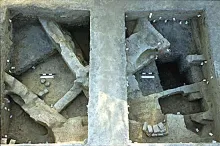
86. Retaining walls inside perimeter wall Towards the east, in what was probably a low area, a series of radiating mud-brick retaining walls were built to contain rubble that was used as a foundation for later structures, only fragments of… |
|
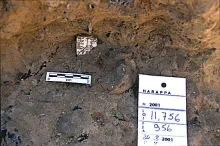
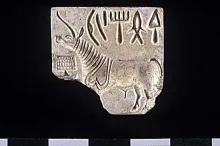
87. Indus unicorn seal in situ In the rubble were found a number of inscribed pieces, including this intaglio seal, seen here in situ next to one of the radiating mud-brick walls. |
|
88. Indus seal Unicorn seal H2001-5139/11,756-01 was broken in antiquity and ended up in rubble foundation debris. |
|
89. Robbed walls of Harappa phase Structures in this part of Harappa were sometimes made of a combination of mud-bricks and baked bricks, sometimes mixed in the same wall as seen here in the case of both the southern part of the… |
|
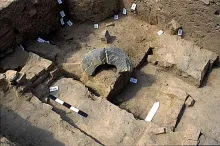
90. Broken Harappa phase ringstone To the Northeast of the area shown in Image 449, the remains of a broken ringstone were found in the upper fill just to the North of the northern wall of a room. (See plan in 85.) This is reminiscent… |