
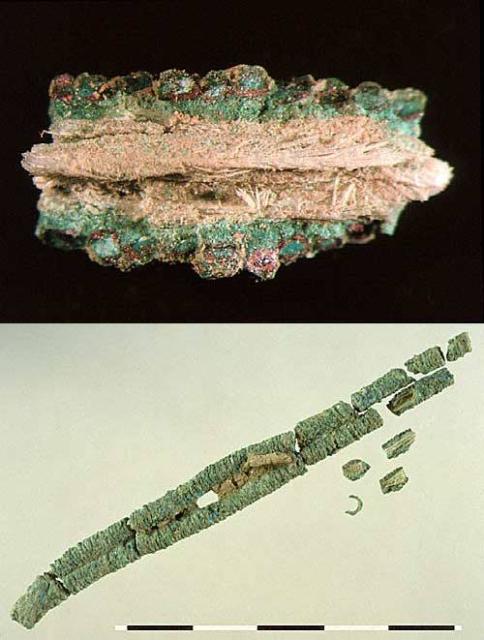
This unique discovery of a coiled copper-alloy wire necklace (H2000/2242-01) dating to Harappa period 3B (circa 2450-2200 BC) is the earliest evidence for silk in South Asia. It has traces of fibers preserved on the inside. Recent studies indicate that the fibers are from the wild silk moth, Antheraea mylitta, commonly called "Tussar" silk today (Irene Good, J. M. Kenoyer and R. H. Meadow 2008).
Its discovery demonstrates that silk production may have first been used to make fine threads for necklaces and only later used for weaving fabrics. The copper wire on this necklace is also among the earliest evidence for finely made wire in the Indus Valley. This type of wire is likely to have been made by drawing the wire through a series of graduated perforations.
For two papers on the silk discovery see Ancient Textiles of the Indus Valley Region and New Evidence for Early Silk in the Indus Civilization.
See also Composite Tubular Gold Bead.