Home

Main navigation

  • home
  • slides
  • essays
  • articles
  • books
  • video
  • q & a
  • blog
Secondary menu
  • about us
    • scholars
    • privacy
    • support
    • image rights
    • credits
    • contact us
  • resources

Ancient Indus civilization textile related materials.

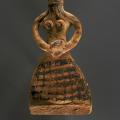
Figurine

Early Harappan female figurine holding a bowl in her two hands. The face is painted with bold eyes and a necklace with pendant beads is painted at the throat. The lower body is decorated with cross hatched painted design that may indicate the patter… >

Textile Evidence

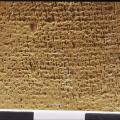
The earliest evidence for normal weave textiles at Harappa is found in this impression on a Ravi Phase bead from Harappa, dating to around 3300 BCE. This fragment is only 1 cm long. Normal weave denotes interlacing single threads (one thread over/un… >

Textile impressions

Textile impressions on a toy bed made during the Harappan Phase (c. 2600-1900 BCE) show finely woven cloth made of uniformly spun threads. This example shows a fairly tightly woven normal weave. >

Copper razor

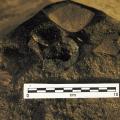
A copper razor (H2000/2164-01) was found in the debris layers at the edge of the kiln dump in Trench 54. Wrapped with fibers, pseudomorphs and impressions of which are preserved in the in the corroded copper, this type of curved razor may have been … >

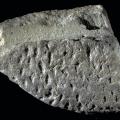
Fragment with fabric impression

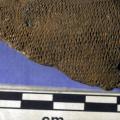
A terracotta fragment with fabric impression from Trench 54 provides clues on the types of weaving carried out by the ancient Harappans. >

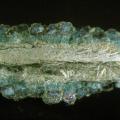
Coiled wire necklace

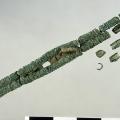
This unique discovery of a coiled copper-alloy wire necklace (H2000/2242-01) has traces of fibers preserved on the inside. Recent studies indicate that the fibers are from the wild silk moth, Antheraea mylitta, commonly called "Tussar" silk today (I… >

Fiber pseudomorphs

Fiber pseudomorphs preserved by copper salts on the interior of the coiled copper necklace (Slide 38) have been analyzed using various techniques and determined to be silk from the wild silk moth, Antheraea mylitta, commonly called "Tussar" silk tod… >

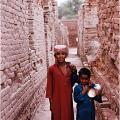
Kids in Mohenjo-daro

These two local boys decided to hang out in the ancient city after delivering a pot of milk to their father who is one of the site watchmen. The distinctive decorated hat worn by the older boy is worn throughout Sindh province in Pakistan. >

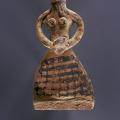
Early Harappan female figurine with painted features from Harappa

Another style of Early Harappan female figurine holds a round object, possibly a vessel, with both hands at the waist above a flaring lower body which ends in a (broken) forward-extending base. The hair is bound at the back of the head into a tiered… >

© Harappa.com 1995-2026 31