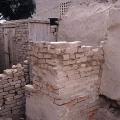
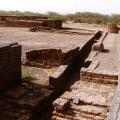
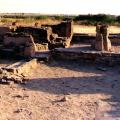
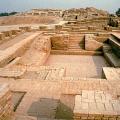
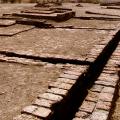
The proximity of the seat of power to the warehouse may have ensured that the ruler and his entourage could inspect stocks easily. An ivory workshop in the acropolis suggests that elephants may have been domesticated to produce the raw material. >
The "great bath" is without doubt the earliest public water tank in the ancient world. The tank itself measures approximately 12 meters north-south and 7 meters wide, with a maximum depth of 2.4 meters. Two wide staircases lead down into the tank fr… >
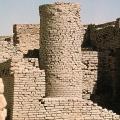
Private wells were rebuilt over many generations to serve the needs of a large household or neighborhood. This well in DK G area at Mohenjo-daro stands like a chimney because all of the surrounding earth has been removed by excavation. >
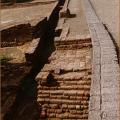
The most unique aspect of planning during the Indus Valley civilization was the system of underground drainage. The main sewer, 1.5 meters deep and 91 cm across, connected to many north-south and east-west sewers. It was made from bricks smoothened … >
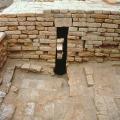
Almost every house unit at Mohenjo-daro was equipped with a private bathing area with drains to take the dirty water out into a larger drain that emptied into a sewage drain. Many of these bathing areas had water tight floors to keep moisture from s… >
Sink for collection of water in the form of an earthen jar with channel cut out of a brick. A jar, numbered A (f) 160,insitu. Sahni mentions a large earthen jar near a bathing platform in Trench A (f), near the circular structures: “… >