Home

Main navigation

  • home
  • slides
  • essays
  • articles
  • books
  • video
  • q & a
  • blog
Secondary menu
  • about us
    • scholars
    • privacy
    • support
    • image rights
    • credits
    • contact us
  • resources

Ancient Indus civilization and earlier examples of pots.

Small pot

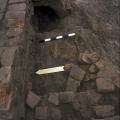
A small pot was found on the floor just to the west of the large globular vessel (the big hole in the wall is where it once sat). In the foreground are other large jars set into the floor and used as hearths or garbage pits. Trench 38, Late Harappan… >

Two Pots Jars In Situ Harappa

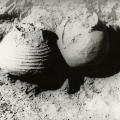
Two jars side by side. One with ribbed surface and field number ‘A (?illegible) 30’. >

Pot Lying East of Earlier Sepulchre

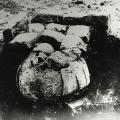
A (e) 308 earthen jar lying to the east of earlier sepulchre in trench A (e). A jar insitu. For Sahni’s description of trench A (e) in Mound F, and its contents, see ARASI 1924-25, pp. 75-76. There is no mention of this eart… >

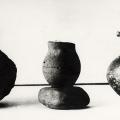
Terracotta Objects Harappa

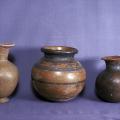
Three jars, the one in middle on a stand, has a band of two incised lines in the middle. Left: the surface has impressed marks on clay. Flat bottom. >

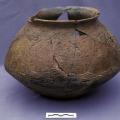
Ravi Phase Cooking Pot

Cooking pots during the Ravi Phase were made in large globular shapes that had a low center of gravity to keep them from tipping over when filled with food. In order to protect the fine clay from cracking due to the heat of the fire, the exterior wa… >

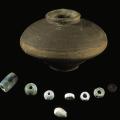
Small pot

A small pot dating to the Period 3C of the Harappa Phase (c. 2200-2000 BCE) was found in excavations on Mound E in 1998. This tiny pot contained fired steatite beads similar to those made during the Ravi Phase as well as faience beads and beads made… >

Three vessels

Three vessels of the Late Harappan Cemetery H period (after 1900 BCE). In the center is a small painted globular pot from a burial group. These forms and their surface treatments are quite distinct from the characteristics of the preceding Harappan … >

© Harappa.com 1995-2026 31