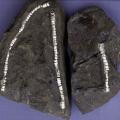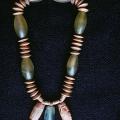
Fragments of a steatite bead necklace recovered from the floor of a house dating to the Ravi Phase (circa 3100 BCE, see 9). The beads have been fired and glazed. >
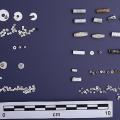
Steatite beads from the Early Harappan Periods at Harappa. On the right are many different styles of Ravi Phase beads (circa 3300-2800 BC). Note the blue green glazed bead in the center and the row of unfired beads in the second to the bottom row. T… >
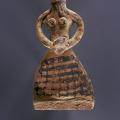
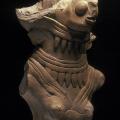
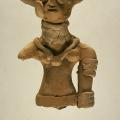
One of the largest female figurines found at Harappa has a (badly broken) fan-shaped pannier headdress with black residue in the cups of the panniers and a forward-projecting face. She is heavily ornamented with an elaborate choker and two other nec… >
Some of the ornaments on female figurines were accentuated with white and/or black pigment, and some ornaments were completely rendered in pigment. One female figurine has a choker, a necklace, and bangles on the left upper and lower arm, all painte… >
Necklace from Mohenjo-daro made from gold, agate, jasper, steatite and green stone (lizardite or grossular garnet). The gold beads are hollow and the pendant agate and jasper beads are attached with thick gold wire. Steatite beads with gold caps ser… >

Early Harappan female figurine holding a bowl in her two hands. The face is painted with bold eyes and a necklace with pendant beads is painted at the throat. The lower body is decorated with cross hatched painted design that may indicate the patter… >
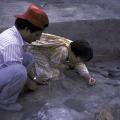
Conservators very carefully excavate and consolidate a necklace of terra cotta beads found in the Ravi Phase levels at Harappa in 1998. On the left is Arif Husain of Karachi University assisting Elizabeth Robertson of the Smithsonian Institution. >