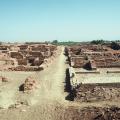
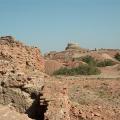
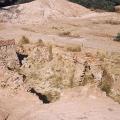
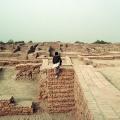
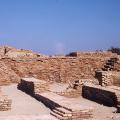
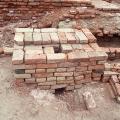
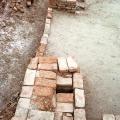
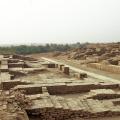
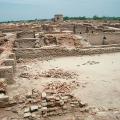
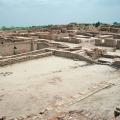
Looking south along Street 3, which runs parallel to First Street in HR area. Agricultural fields and scrub jungle south of the site are visible in the distance. >
A massive block of brick architecture at the southeast corner of the "citadel" mound was thought to represent a gateway with large brick bastions. Later construction of a wall (in the center of the photo) blocked the entryway. >
Looking from the top of the granary towards the remains of two wells and the wall that were constructed in the area to the north of the structure. The drain from the great bath would have run along the modern pathway. >
Many houses had stairs leading to upper courtyards of the building or to a second floor. This house in HR area had a double staircase that would allow people to enter and exit the upper courtyard in an orderly fashion. Some scholars feel this may ha… >
House A1 may have been a temple or palace of an important leader. Two doorways lead to a narrow courtyard at a lower level. A double staircase leads to an upper courtyard surrounded by several rooms. This house had numerous seals and fragments of a … >
Toilets would have been an essential feature in Mohenjo-daro, but the early excavators identified most toilets as post-cremation burial urns or sump pots. This brick structure (one of two - see Slide 48) had a hole in the top that was connected to a… >
Two structure with a hole and drain located are thought to have been toilets. While these two structures may have been unique examples of toilets, most people would have used old pots set into the ground as commodes. >
The small lane at the left side of the photograph was called Dead Man's Lane because of the discovery of a single skeleton where the wall juts out into the lane. The large street running north south is First Street. The room with the so-called massa… >
In some neighborhoods, large courtyards were connected to numerous smaller buildings built at different levels. The pilastered wall on the left supported houses at a higher level. A large corbelled arch drain that was later blocked is seen emerging … >
A small room located at the edge of the street (in the center of the photograph) is where fourteen skeletons of so-called massacre victims were discovered. >