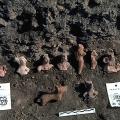
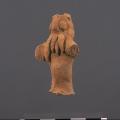
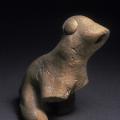
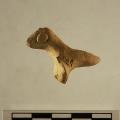
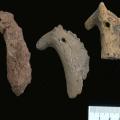
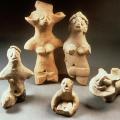
A few figurines are not clearly male or female, or even anthropomorphic or animal. One unusual recently discovered figurine has no clear sex characteristics. It does have two projections (broken off) that pointed forward from the back of the head as… >
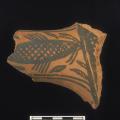
Painted designs on figurines occasionally reached the level of those often found on Harappan pottery, especially in the later periods. An interesting combination of figurines with pottery was the occasional addition of animal heads to pottery, eithe… >
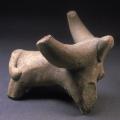
Some quadruped figurines are difficult to classify because the general form and many of the attributes of humpless cattle, water buffalo, and even rams may be very similar. Any of the three may have incising on the face and/or horns. Sometimes the s… >
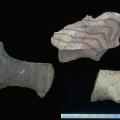
Although many animal figurines have identifiable traits (e. g., the applied "hide" and horn typical of a rhinoceros figurine), some figurines are not readily identifiable. Animal figurines that are badly broken are sometimes particularly difficult t… >
Several types of birds are represented in figurines. Bird figurines with long tapered tails probably represent parakeets. These birds often have flattened stylized feet that were attached to other terracotta objects such as cages of which there are … >
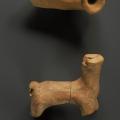
A different style of quadruped body has a vertical neck shaft for attaching and possibly changing the (separate) head. Figurine heads with this type of neck shaft include the markhor heads discussed earlier (see image #40). Approximate dimension… >