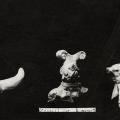
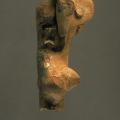
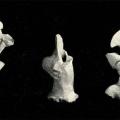
Smaller items start getting grouped for the photographs, in photographs from subsequent years we start to see many more objects grouped in each image. [1] Terracotta head, left. Terracotta bull, right. "Harappa offers a greater variety of ani… >
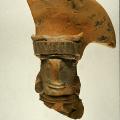
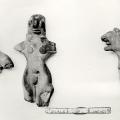
A few female figurines from Harappa have a sort of "tiara" attached to the front of the fan-shaped headdress. Approximate dimensions (W x H x D): 6.0 x 8.7 x 3.9 cm. >
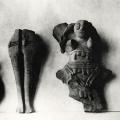
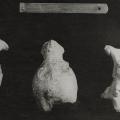
Three are female, the fourth, second from left is of the lower part of a finely modelled figure. Find no. A 127. Right: has a thick braid. Second from right: wears “a distinctive headdress which rises fan like from back of the head… a close fi… >
Other female figurines have a double volute headdress that is usually decorated and sometimes painted black as well. Female figurines are usually depicted standing with their legs pressed together all the way to the feet and sometimes have their han… >
Two terracotta male figurines, nude. Left: Male figurine, nude, published in Vats 1940 (Vo. II), no. 21. Find no. A. 19, 1.7 in high “found at a depth of 2 ft. 6 in. b.s., in Mound F, Great Granary Area, Stratum I” (Vats 1940, p. 296) Vats… >
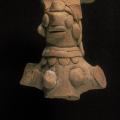
The "cones" that often decorate figurine headdresses may be reproductions of the small gold cones that have been found at Indus Civilization sites. Similar small gold cones are still used as hair ornaments in South Asia. Approximate dimensions (W… >
It is appropriate that Daya Ram Sahni quickly found female figurines on Mound F at Harappa as he made the first incisions. Female figurines greatly outnumber those of men at ancient Indus sites. >
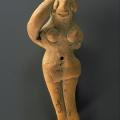
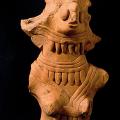
Female figurine with three sets of chokers and necklaces. This is one of the largest female figurines found at Harappa and it has the common fan shaped headdress with cups on either side of the head. Traces of black pigment or soot have been foun… >
In addition to headdresses and hair decorations, loose hair is sometimes depicted on figurines. A few figurines have painted black hair extending from the back of the head to below the shoulders. Approximate dimensions (W x H x D): 3.9 x 5.2 x 2… >
Daya Ram Sahni quickly recognized the preponderance of female figurines; after describing the two male figurines found, he writes: "All the other human figures are female figures (Plate X, Photo. No, 2807-b) which appear to be crude cari… >