Home

Main navigation

  • home
  • slides
  • essays
  • articles
  • books
  • video
  • q & a
  • blog
Secondary menu
  • about us
    • scholars
    • privacy
    • support
    • image rights
    • credits
    • contact us
  • resources

Ancient Indus Valley civilization burial related materials.

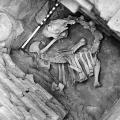
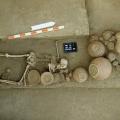
Burial of woman and infant, Harappa

This burial was disturbed in antiquity, possibly by ancient Harappan grave robbers. Besides the fact that the body is flipped and the pottery disturbed, the left arm of the woman is broken and shell bangles that would normally be found on the left a… >

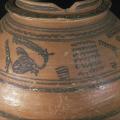
Large burial urn

Late Harappan Period large burial urn with ledged rim for holding a bowl-shaped lid. The painted panel around the shoulder of the vessel depicts flying peacocks with sun or star motifs and wavy lines that may represent water. Cemetery H period, afte… >

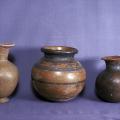
Three vessels

Three vessels of the Late Harappan Cemetery H period (after 1900 BCE). In the center is a small painted globular pot from a burial group. These forms and their surface treatments are quite distinct from the characteristics of the preceding Harappan … >

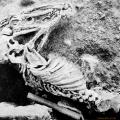
Camel Skeleton Mohenjo-daro [34]

  • Camel Skeleton Mohenjo-daro

Area not known Overview of a camel skeleton (Camelus sp.) that was buried in a pit associated with buildings made from complete and broken Harappan. Meadow (1984:134) suggests that the structures were built in the later part of the Harappan Perio… >

Camel Skeleton Mohenjo-daro [29]

  • Camel Skeleton Mohenjo-daro

Area not known Overview of a camel skeleton (Camelus sp.) that was buried in a pit associated with buildings made from complete and broken Harappan. Meadow (1984:134) suggests that the structures were built in the later part of the Harappan Perio… >

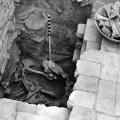
A typical burial in the second stratum of Cemetery at Harappa

[Original 1931 text] "At Harappa several examples of this mode of sepulture [complete inhumation], which are unquestionably orthodox, have already been expposed in the lower stratum of Cemetery H, and more are likely to come to view as the excavatio… >

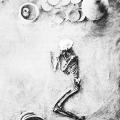
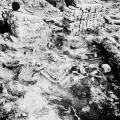
Portion of skeleton found above southern wall of Room 74, House V

[Original 1931 text] On 29th December, 1925, 1 foot below the surface, part of a skeleton was discovered above what proved later to be the southern wall of Room 74 of House V, Section B. All below the pelvis, save the head of the right femur, which … >

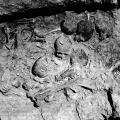
Group of skeletons in Room 74, House V.

  • Group of skeletons in Room 74, House V.

Photographed between 1922-27 and published in Sir John Marshall, Mohenjodaro and The Indus Civilization (1931). >

Mound C Ossuary

This ossuary or collection of bones on Mound C is from the Mundigak Period III [3400-2900 BCE]. Towards the end of Period IV [2900-2400 BCE] , it seems as if the "palace" and "temple" were burned down, and not re-inhabited although other parts of th… >

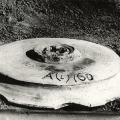
Human bone under an earthen dish cover

Cover of a jar, Terracotta, field number A(i) 160. Of trench A (i) in Mound F, Sahni: “The trench Ai (100' x 31') excavated to the east of the one described above [A (e)] revealed at the depth of 5' a large mass of earthen bowls with pointed base… >

Pagination

  • Page 1
  • Page 2
  • Next page
  • Last page
© Harappa.com 1995-2026 31