Home

Main navigation

  • home
  • slides
  • essays
  • articles
  • books
  • video
  • q & a
  • blog
Secondary menu
  • about us
    • scholars
    • privacy
    • support
    • image rights
    • credits
    • contact us
  • resources

Wayne Belcher

Slides on 3D models and recreations of the ancient Indus Valley by Wayne Belcher

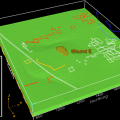
Period I Cultural Stratigraphy

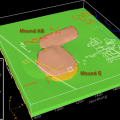
Using maps and cross-sections of the cultural deposits from HARP, surfaces were generated to represent the interfaces of cultural layers in the mounds at Harappa. This represents the growth of the city of ancient Harappa vertically and through time… >

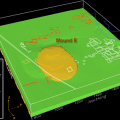
Period II Cultural Stratigraphy

Period 2 deposits represent a transition phase between pre urban and urban phases and exist primarily beneath Mound E. >

Period IIIA Cultural Stratigraphy

Period 3A deposits, representing an early urban phase, exist beneath Mounds E and also show expansion onto the area beneath Mound AB. Growth in the city of Harappa is shown to be both lateral and vertical. >

Period IIIBC Paleotopography

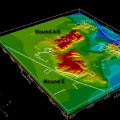
Period 3B and 3C deposits essentially cover the entire modeled area and represent the greatest extent of the ancient urban center. J. M. Kenoyer has developed a model describing some of the processes that contribute to the urban growth at Harappa… >

Period IV-V Paleotopography

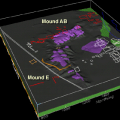
Periods 4 and 5, representing a modification of cultural styles, exist at the tops of Mounds AB and E. >

Periods I-V Stratigraphic Cross-Section

Period IV-V 1900-1700 B.C. Period IIIBC 2450-1900 B.C.Period IIIA 2600-2450 B.C.Period II 2800-2600 B.C.Period I 3300-2800 B.C. Pre-Occupation before 3300 B.C. The purpose of this continuing research is to develop a system for… >

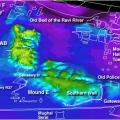
Harappa Archaeological Site Topography

Photograph of Mound AB. There also appears to be a smaller mound that is present at the modern Harappa town site. This could be a modern representation of the processes that built ancient Harappa. This is especially noticeable since the surrounding… >

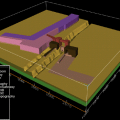
Mound E/ET Gateway Area Reconstruction

The gateway area is located at the southeast corner of Mound E and is part of a mudbrick perimeter wall that was first recognized in 1990. The bastion area consists of a Period 3B (2450-2200 B.C.) wall built upon a Period 3A (2600-2450 B.C.) wall, w… >

Mound E Gateway Reconstruction

Using interpretations presented in Meadow and others (1995), a reconstruction of the bastion/gateway area was completed in EarthVision. The computer reconstructions were based on an artistic rendering completed by HARP archaeologists. These reconstr… >

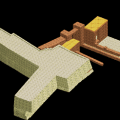
Mound E/ET Gateway on Southern Wall

The structures located at the southeastern corner of Mound E consists of a complex of massive baked brick/mud brick walls and baked brick drain complex. This series of structures is set between the southeastern corner of the mud brick city wall of M… >

Pagination

  • Page 1
  • Page 2
  • Next page
  • Last page
© Harappa.com 1995-2026 31