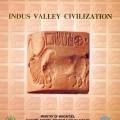
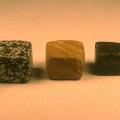
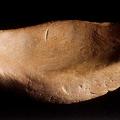
Steatite (soapstone) artifacts have been found at nearly every excavated Harappan period (2600-1900 BC) site and were the primary element used to make seals. >
In November 2000 the authors conducted collaborative fieldwork to identify salt and mineral resources from the Salt Range in the Punjab, Pakistan used by the prehistoric site of Harappa over 200 kilometers away. >
The exchange and communication systems that connected distant parts of the Indus Civilization (c. 2600 to 1900 BC) and beyond had roots beginning in the early Neolithic period. >
The origins of manufacturing debris recovered from different periods of occupation between 3300 BCE and 1700 BCE at Harappa can now be identified with a high degree of certainty thanks to geologic source provenance studies. >
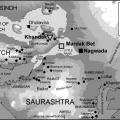
The author's propose a method to analyze some of the largest artifacts recovered at Indus Civilization (ca. 2600 to 1700 BC) cities in Pakistan and northwestern India, the limestone “ringstones.” This later led to the determination that Harappa's ringstones came from near Dholavira. >
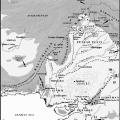
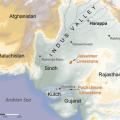
Harappa’s rock and mineral assemblage from the perspective of the greater Indus Valley’s complex geology, the distance one would have to travel to acquire certain materials and a discussion of the differing motivations behind the acquisition and transport of rock and minerals in the greater Indus Valley region. >
"Recent discoveries of Indus and Indus related materials at sites in the interior, and a general reassessment of comparable materials throughout Oman, suggest a more complex model of interaction. . . these artefacts probably reflect the presence of small groups of Indus merchants and craftspeople integrated into local communities and directly involved with important socioeconomic activities." >
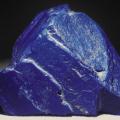
"Lazurite - the constituent of lapis lazuli that gives the rock its blue color - is a rare mineral in nature," writes Randall Law, and there is likely to have been only one source in the region during ancient times, the Badakhshan mines in Afghanistan. >
"Geologically speaking," write the authors, "agate is not a particularly uncommon rock . . .. However, good agate – i.e, that which ancient lapidaries would have found suitable for beadmaking – is not widely available. Nodules of the size and quality required to make Harappan-style long-barrel carnelian beads are, in fact, extremely rare" (p. 177). >