

Geography and Chronology (cont.)
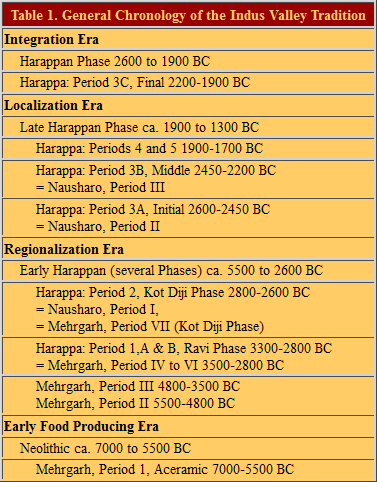
The next Era is called the Integration Era (2600-1900 BCE) and is the time generally associated with the term "Indus Valley civilization". This Era is characterized by the emergence of numerous urban centers and smaller regional towns. At this time we see the common use of a writing system found primarily on pottery or on inscribed seals and tablets. Standardized cubical stone weights are found at all major sites along with similar styles of pottery vessels and a wide range of other objects. Various categories of evidence, some of which will be discussed below indicate the presence of distinct social and economic classes, both within the cities, as well as in the surrounding hinterland. Perhaps even more important is the evidence for political and ideological integration of major settlements and the emergence of what may be termed "city states" (Kenoyer 1997a).
The final Era of the Indus Tradition is referred to as the Localization Era (1900-1300 BCE). During this time there is evidence for major transformations the socio-economic and political organization of cities and regional settlements. While there are some important continuities that link this period with earlier cultures, there are nevertheless significant changes in technology and production that are in turn linked to changes in stylistic and symbolic aspects of the material culture. The most significant changes are seen in the disappearance of Indus writing, standardized weights, and the breakdown of long distance trade. By the end of the Localization Era, the socio-political and ideological aspects of the Indus Tradition have been radically transformed and reflect the emergence of a new cultural tradition that incorporates a much wider geographical area extending from the Indus to the Ganga and Yamuna alluvial plains (Kenoyer 1995a).
Early Food Producing Era: Art and Symbol
The early use of material objects as symbols to define social status and power in the Indus valley can be documented at the site of Mehrgarh, which is the major site for understanding the Neolithic developments in the Indus valley (Jarrige et al. 1995) . The Neolithic occupation reveals a rich assemblage of material culture from both domestic and burial contexts. Of particular importance are the craft technologies and the Neolithic burials which reflect the economic and ideological patterns during this initial phase of settling down. The types of artifacts that may have been used as symbolic objects are relatively limited, but this may be due in part, to the fact that few permanent materials, such as stone, shell and bone, were used for the creation of decorative objects.
The semi-sedentary agro-pastoral communities living on the Kacchi plain or on the Quetta Plateau had begun to exploit domestic plants, such as wheat and barley, and animals such as sheep, goat and cattle (Meadow 1996). At Mehrgarh there is evidence for simple mud walled buildings with four internal subdivisions and numerous burials with often quite elaborate burials offerings (Jarrige, Jarrige et al. 1995). In addition to occasional animal sacrifices, these offerings included baskets, stone and bone tools, and a wide range of ornaments such as beads and bangles (Barthélémy de Saizieu 1990). In the absence of fired pottery, the most important types of containers were baskets and presumably bags made with netting, woven fabrics or leather. Bitumen coated baskets and intricately designed beaded ornaments indicate considerable expertise in various types of weaving. The combinations of different colors of stone or shell indicate a preference for contrasting colors such as unfired black soapstone and white limestone, shell or fired soapstone. Bright orange or purple Spondylus shell disc beads were combined with beads made from blue-green turquoise, deep blue lapis lazuli, banded sandstone and even polished copper. Wide shell bangles were worn along with bracelets and anklets made from tabular beads of white shell or white limestone (Kenoyer 1995b). Natural shell beads from brown and white striped Engina mendicaria were also used, often in combination with large disc pendants made from the flat spire of the cone shell (Conus sp.). Many of these same materials continued to be used in later times and with the development of more complex technologies for production, some came to be used as important symbolic and wealth objects during the Harappan period (Kenoyer 2000).
Technology
The technologies used to create ornaments were not very complex during this period and involved relatively simple procedures of chipping, grinding and drilling (Vidale 1995). Since no evidence of manufacture of exotic materials has been found from Mehrgarh during this early period, it can be assumed that ornaments from non-local materials were produced by craftsmen/women in distant resource areas and traded to the settlement in finished form (Jarrige et al. 1995; Kenoyer 2000). It is not unlikely that communities in the western Baluchistan highlands may have been active in the manufacture or trading items such as lapis and turquoise beads, marine shell beads and native copper beads, all of which have been found in early burials at Mehrgarh. In addition to this highland trade of exotic commodities there is a possibility that some items, such as large shell bangles made from the marine shell Turbinella pyrum were traded up the Indus valley and reached the site from this other direction.