A Unicorn Seal Text


| Description | Dimensions of the Seal | Materials and Technique |
| Place of Discovery | Iconography | Dating | Publication |


"The (Harappan) animal seals are among the world's greatest examples of an artist's ability to embody the essentials of a given form in artistic shape." (Benjamin Rowland 1967)


Description


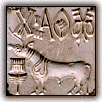
The Harappan seal in the Edward Gans Collection (Phoebe A. Hearst Museum of Anthropology, University of California at Berkeley, Slide 1) is a classic fired white steatite square Harappan seal of 29mm x 29mm. The unicorn motif and the square shape are predominant features of Harappan seals, the carving is finely executed and the seal is well preserved. During the Mohenjo-daro excavations of 1927-1931, in which this seal was unearthed, 388 unicorn seals were found (Mackay 1938). Mackay suggested that the artist may have been trying to portray one horn behind the other, but due to the craftsman's limited skills at depicting perspective, only one horn was indicated. This convention is seen on archaic Sumerian seals as well. Previous to Mackay, Marshall, in his 1922-1927 expeditions at Mohenjo-Daro, found a total of 558 seals (Marshall 1931). All were similar to this one with only one or two lines of "pictographs" and a single animal motif. Most of these were square or rectangular with a perforated boss on the back. Almost all of the square seals were made of steatite but the thickness of the seal varied greatly. A wide variety of other inscribed objects were found at Mohenjo-daro, some of which were intaglio seals, while other items were inscribed tablets or tokens. The shapes of these small objects include cylinders, squares with perforated boss, squares with no boss and tablets or tokens frequently inscribed on both sides, rectangular tablets without a boss, button seals with linear or geometric designs, rectangular with perforated backs, incised cubes, circular with perforated bosses, rectangular with perforated bosses and circular without bosses but inscribed on both sides.

While many people focus on the aesthetic qualities of these inscribed objects, we must remember that these were also functional objects. The seals appear to have been used extensively in both internal and external trade (map).

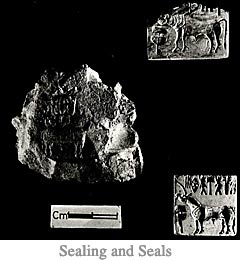
Numerous impressions of seals have been found on ceramics (Josh) and Parpola 1987:103) as well as on "tags" or bullae used to seal bundles of trade goods (Josh) and Parpola 1987:273). Traces of rope impressions on the back of many "tags" indicates that they were applied to bundles of goods, possibly to denote ownership or for security purposes. The sealing or the seal itself could possibly carry the symbol of power or authority of office. The motif on the seal and/or impression may have functioned as an amulet as well.

The agricultural scientists Frederick and Elizabeth Simoons became fascinated with a contemporary sacrificial bovine, the mithan, while working in Assam on the northeastern fringes of South Asia. In their study on the history of the mithan, they suggested that the type of animal on this seal may represent an urus (or "aurochs"), a large, extinct, longhaired species of wild cattle, Bos primigenius, the ancestor of modern domesticated cattle. It is possible that the unicorn animal may represent a pre-domesticated form of bull. The collar, garland and necklace may indicate the fact that it was used as a sacrificial animal (see further discussion below). Upon close observation the so-called "manger" or trough which sits in front of the animal may in fact be a bale of fodder (the upper object) and the lower object resembles wicker work which may have been sealed to hold water.
Return to top

Dimensions of the Seal


The square shape of the seal is the most common form of these stamp-seals although there is great variety in their external dimensions and thickness. The perforation is probably for a cord which passed through the center of the handle. Dales (1976) reports that the seal measures 28mm x 28mm, but my measurements indicate that it is in fact 29mm square.

ShapeSquare
Size 29mm * 29mm 1.14in * 1.14in
Thickness (without handle)8.5mm.33in
Thickness (with handle) 14.5mm .57in
Length of handle13.5mm .53in
Width of handle14mm.55in
Diameter of perforation 2.5mm.098in
Weight 9.5gm .34oz


Mackay notes with some authority, considering the large number of seals he worked with, that most of the bosses were uniform in cut and shape. The perforation always runs in the direction of the animal's body, so when suspended, the representation of the animal is properly oriented. Marshall (1931) remarks that most of the bosses on the seals found in his excavation occupied approximately a third of the area of the width of their backs. The boss on this seal is centered on the back and is also equal to about 1/3 of the area of its back. Marshall also noted that the bosses, or handles, appear to be hemispherical in shape although a groove down the center can give them the illusion of being double. Weights for seals are not provided for by earlier researchers, so it is not possible to compare absolute weight of seals. This seal is 9.5 grams and it appears to be typical of other unicorn seals found at Mohenjo- daro and Harappa.
Return to top

Materials and Technique


The usual material for Harappan seals is fired steatite, as is this example. The other materials used to make seals and tablets (which are in many cases scalings) include terra-cotta, quartz paste, silver, faience, calcite, ivory, marble, and limestone. Steatite is a soft stone (I on the Mohs' scale of hardness) and is easily carved. When it is fired to approximately 950 degrees C, the hardness is increased to 3.5 on the Mohs' scale and it is transformed to enstatite(Collon 1986). The stone was invariably carved and incised prior to firing, after which it would have been extremely difficult to carve the detailed designs. The stages of seal manufacture are described below:

"The stone seals were first cut into shape by means of a saw, the marks of which are clearly seen on unfinished seals or those that have been altered.... After the seal had been cut to the size required, if it was to have a boss, this was roughly cut into shape with the saw; a horizontal cut was made from each side of the seal towards the centre and four vertical cuts were then made downwards to meet the horizontal ones. A rough square projection, the size of the boss, was left at the back of the seal. The boss was then carefully rounded off after the groove that always runs across its centre had been roughly made by a V-shaped cut. The rounding of the boss was apparently done with a knife and finished off with an abrasive, after which a hole was bored through it from opposite sides to take a cord. The hole for the cord was sometimes bore horizontally, but more generally it dips slightly from the two ends towards the centre. As steatite has a tendency to split along the cleavage planes, the probable idea of these converging holes, which are too common to be accidental, was probably to carry the hole into the substance of the seal itself rather than to rely solely on the boss, which owning to its prominence and the nature of the stone was always liable to be knocked off" (Mackay in Marshall 1931: 377)

All of the fired seals have a glossy surface which Mackay thought was a form of glaze that may have been used to cover the surface of the steatite prior top carving (Mackay in Marshall 1931:379). The design appears to have been outlined with a chert burin or copper engraving tool. These are no evidence that drills were used in the manufacture of the seal other than in the "cult" (wicker work?) object and obviously for perforation of the boss. The inscription was probably added after the rest of the engraving was completed. It is thought that an alkali coating was applied to the dark steatite prior to firing and this helped to harden the surface and also turned the dark steatite white. Mackay notes, after examining hundreds of samples, including the seal featured in this article, that there was a certain amount of lamination in the stone coat which most likely was caused either by the application of alkali in repeated coats or by overlapping brush strokes. This seal however, does not exhibit any lamination of brush strokes. Chemical analysis was made of the glazed surface of one of the seals unearthed at Mohenjo-daro expedition, and the results indicated that "this surface substance is steatite or talc that has been deprived of the greater part of its water, which is only possible by ignition" (Sana Ullah in Marshall 1931:379).

The "glazed" surface tends to crack and flake off and this type of weathering has occurred on all four corners of this seal, exposing the darker steatite below.

Surface Composition based on Sana Ullah's analysis:


  • Silica - 61.2 %
  • Oxides of aluminum and iron - 2.4 %
  • Lime - Nil.
  • Magnesia - 34.6 %
  • Water (by difference) - 1.8%
  • Total - 100.00%
Return to top

Place of discovery


This seal was uncovered during excavations at Mohenjo-daro (Figure 17.2) by E. J. H. Mackay between 1927 and 1931. The field number for this seal is DK 10107, No. 23 (Mackay 1938: Vol.1, 370, Vol. 2, Pl. LXXXIII:23). This seal was found 3.8 feet below the surface level in the DK Area, Section G, Block No. 22, House II, Room 10 (Slide 4). Unfortunately, Mackay gives us only tempting tidbits regarding the archaeological context of this seal. Dating is fairly difficult, a matter discussed in more detail below. The published information states that the seal was found in House II, but there is only one large house in Block 22. The excavations levels defined by Mackay indicate that Period Ia only goes down to 3.2 feet below surface. Since the seal was recovered from room 10 at a depth of 3.8 feet it would mean that the seal may date to late Period Ib Mackay felt that the building itself might have existed as far back as Late Phase m and possibly earlier. Mackay concludes his comments about the house in Block 22:

"I am inclined to think that this building was the house of some rich personage, for it is very compact and the arrangement of the rooms would not have admitted of a large number of people living in them. Indeed, it is possible that it was built for the custodian or controller of the great building adjacent to it on the west" (Mackay 1938:154).
Return to top

Iconography


Parpola says the interpretation of the iconography of the Harappan seals remains a major scholarly challenge (Joshi and Parpola 1987). Looking through the first volume of the Corpus of Indus Seals and Inscriptions, it is clear that male bovines were important symbols to the people of the Indus Valley Civilization. The Harappans seem to have been an integral yet marginal part of the ancient West Asian cultural area where the bull was a central motif. Even today in Hindu South Asia, the bull is an important symbol, for example Nandi as the vehicle for Siva. There seems to be a continuity in the symbolic importance of the bull/bovine in antiquity from West Asia eastward and especially in SouthAsia where it continues in the modern era.

Please note there are clearly carved collar, garland and necklace on the unicorn. Sacrificial animals in village India are often garlanded and decorated in similar ways today. Frederick and Elizabeth Simoons (1968) write that several types of cattle had ritual significance to the Harappan people. They point out that the Rgveda, one of the earliest "texts" of the Indo-Aryan speaking communities refers to the capture of wild cattle for ritual sacrificial purposes (Simoons, 1968). In these Vedic texts, the bull is a symbol of masculine virility. The Vedic texts are the earliest decipherable literature from the former area of the Harappan culture, and it is impossible to gauge how much influence Harappan ideas had upon the people who composed and complied the Vedic texts. However, it is clear that both cultures had cults in which the bull was a significant symbol. As was true of the bulls of the Vedic period, those of the Harappan period seem to have been involved in fertility rituals in which their slaughter was integral. The problem of the so-called "cult" object in front of the unicorn in the seal is more complicated.

There are four different opinions attempting to identify this object in front of the unicorn. First, both Marshall (1931) and Mackay (1938) say it is similar to a feeding trough or "manger" which they had seen in Sindh. Second, Simoons and Simoons (1968) allude to the work of a pervious scholar, Wilhelm Koopers, who connects the objects in front of the unicorn to contemporary offering strands used in central India. Third, is another opinion of Mackay's that the object in question may be a cage for insects or birds and, fourth, to still another opinion of Marshall that it may, instead, be an incense burner (Morton 1986MS). We should note that the unicorn always has this type of "cult" object, while other bovines and other species depicted on the seals have either a shallow trough or no "cult" object at all.

At the moment the Harappan script is still undeciphered though some scholars conclude that these "pictographs" represent the writings of a proto-Dravidian language (Josh) and Parpola, 1987; Mahadevan 1982). Iravatham Mahadevan attempts a reading of the terminal signs on some of the seals through computer aided analysis (Mahadevan, 1982). In his essay, Mahadevan concludes that none of the published claims of decipherment are correct. He further notes that the script is clearly not alphabetic and that it is not related to other known pictographic scripts in ancient West Asia or later Indic scripts. He also asserts that the script definitely does not represent an Indo-European language. On the contrary, Mahadevan suggests, that the Harappan script may represent a proto Dravidian language and the script was probably read from right to left. Mahadevan believes that the relationship of the terminal sign to the other signs is probably semantic rather than grammatical. He argues that the Harappan seals probably give the names and titles of users. The Indus names and titles might have passed on into later Indic languages as loan words. The shapes of the Harappan ideograms should have kept significance for later South Asian people. Through comparison with later Indic languages and symbolism, the meaning of some of these signs can be retrieved. Mahadevan is looking for bi-lingual correlates with later Indian languages. In searching for ideographic parallels, he has determined that the terminal sign on a seal such as the one being discussed here indicates the class of person to which the name is attached. The terminal sign on the seals in Harappan script probably work as an ideogram. Figure 17.3 shows five of the most common terminal signs on Harappan seals. The terminal sign on this seal is a combination of the first and third symbols. In Indic culture, the jar represents the priest and Mahadevan argues that this third sign represents a bearer of office. Therefore, he translates the terminal sign on this seal as indicating an officer or profunctory with priestly duties. Until a bi-lingual text is found with a known language to compare to the Harappan writing, it will be impossible to refute or support such interpretations. Unfortunately, the climate of the northwestern subcontinent is not conducive to the preservation of organic materials, such as cured banana leaves, upon which such a bi-lingual text might be preserved.
Return to top

Dating


I place this seal, in the mature urban phase of the Harappan culture for two reasons: First, the refined craftsmanship and second, that most of the known seals come from this period. Carbon dating gives us the rough estimate for the mature urban phase as probably 2550/2300 and 2000/1700 B.C. I estimate the date of the Gans seal to be circa 2000 B.C. (plus or minus 200 years). I use the year 2000 B.C. because the seal was found in a late phase lb archaeological context which means it was in use near the end of the mature phase.

A superior example of an Harappan seal exists on the West Coast of the United States in the Edward Gans Collection housed at the University of California, Berkeley. In most ways it is typical of the class of unicorn seals found at Harappan sites in Pakistan, but it is also a well-preserved and well-crafted object.
Return to top

Publication


This article was originally published as "An Harappan Seal at Berkeley," by Geoffrey Cook in From Sumer to Meluhha: Contributions to the Archaeology of South and West Asia in Memory of George F. Dales, Jr., edited by Jonathan Mark Kenoyer, Wisconsin Archaeology Reports, Vol. 3, Madison, Wisconsin, 1994.
Return to top


| ESSAY | BIBLIOGRAPHY | CONTENTS |

| HOME |

© Harappa 1997