
Harappa Excavations 1995-2001
New light on the recently named Ravi Phase (3300-2800 BCE), the Kot Diji Phase (2800-2600 BCE), and the Harappa Phase (2600-1800 BCE).
|
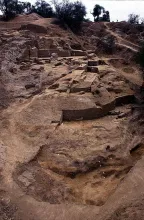
1. Harappa, Mound AB The northern end of Mound AB, shown here from the North, comprises more than 17 meters of occupational debris beginning on top of an old levee of the river Ravi and continuing up from the Ravi … |
|
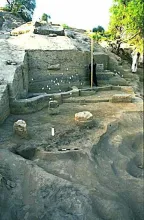
2. Mound AB, Ravi phase View of Harappa Mound AB Trench 39N from the North showing the earliest Ravi [Aspect of the Hakra] phase occupation levels (Period IA, ca. 3300 BC). These levels revealed traces of post molds from… |
|
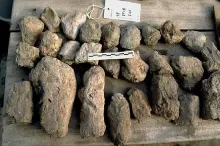
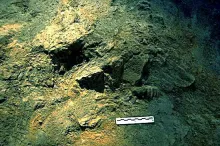
3. Ravi phase hand-formed mud-bricks Ravi phase hand-formed (not in molds) mud-bricks were found in the early levels mixed with ash and broken pieces of pottery. They may originally have been part of a firing structure or kiln. |
|
4. Ravi phase reed impressions Ravi phase houses seem to have been constructed with wooden supports and walls made of plastered reeds. A lump of plaster with reed impressions is seen in this image. |
|
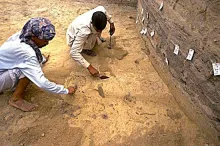
5. Outlining a Ravi phase storage pit Each Ravi phase stratigraphic layer was identified and excavated, and the many rodent holes, obvious both in the exposed area and in the section, were isolated. Here delicate trowel work has revealed… |
|
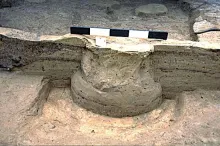
6. Ravi phase pit Normally in archaeology pits are emptied before earlier surrounding layers are excavated. In this case, however, in order to expose vertical sections of both the Ravi phase pit and of the earlier… |
|
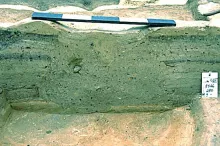
7. Ravi phase pit cross section The cross section of the Ravi phase pit shows multiple episodes of filling and plastering. The contents were collected for flotation, which recovered seeds of barley and wheat as well as some… |
|
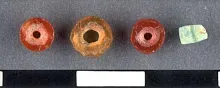
8. Ravi phase stone beads Many broken and unfinished stone beads of carnelian (red-orange) and amazonite (blue-green) were found in the floor levels associated with the Ravi phase pits and hearths. (See also slide 119.) |
|
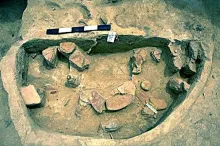
9. Ravi phase pit with trash and beads This large Ravi phase pit was filled with domestic trash and some bead making debris. The broken amazonite bead in (8) can be seen just above the scale inside the pit to the lower right of the image. |
|
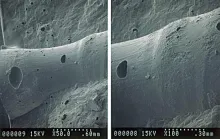
10. Microscopic analysis of bead drill hole Scanning electron microscope photos of a molded impression of the drill hole indicate that the amazonite bead (8) was drilled with a tapered chert or jasper drill. |
|
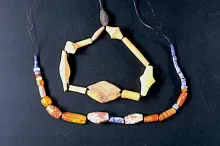
11. Ravi phase beads From different levels of the Ravi phase come these terracotta beads (center string) and hard stone beads made from carnelian, amazonite, and lapis lazuli. |

|
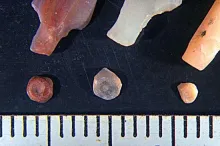
12. Ravi phase microbeads Ravi phase microbeads of lapis lazuli (top row), amazonite, and carnelian (bottom row) indicate the size and nature of the drills used for perforation. The largest of the illustrated beads is less… |
|
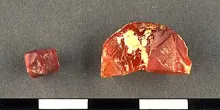
13. Ravi phase carnelian bead blanks Chipped carnelian bead blanks indicate that the initial stages of bead manufacture were taking place in this part of the Ravi phase settlement. |
|
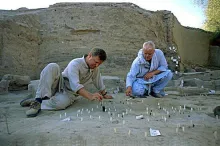
14. Excavating Ravi phase bead debris J. Mark Kenoyer assisted by Peter Eltsov carefully uncover and mark Ravi phase bead manufacturing debris in preparation for mapping and photography. |
|
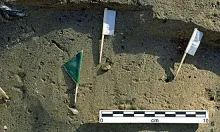
15. Ravi phase microdebitage Ravi phase bead manufacturing debris includes extremely fine microdebitage as well as flakes and drills (marked with the green flag). |
|
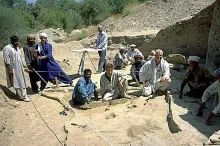
16. Harappa excavators After marking, the entire excavation team is called in to map and eventually collect the bead manufacturing debris and all of the sediment from each layer of Ravi phase floors. |
|
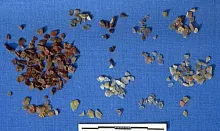
17. Ravi phase microdebitage After wet screening, the Ravi phase microdebitage, larger flakes, broken drills, and even microbeads are sorted according to type of artifact and kind and color of stone. |
|
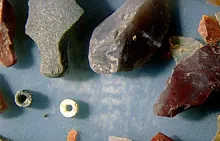
18. Ravi phase steatite microbeads Tiny steatite microbeads (less than 1mm in diameter) such as those seen here were probably perforated with a sharpened copper wire, while stone drills with larger tips were used for carnelian, lapis,… |
|
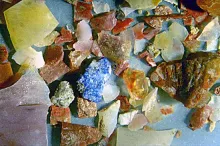
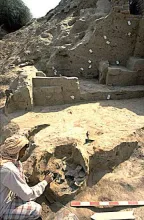
19. Ravi phase raw materials Flakes of various shades of agate, carnelian, jasper, chert, and lapis lazuli indicate the range of raw materials being processed in this part of Harappa during the Ravi phase. All of these raw… |
|
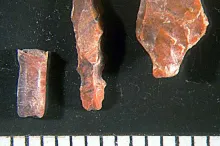
20. Agate drill tips During drilling, the tips of agate drills become hot and often spall off. Fine screens allow the collection of the spalled drill tips, the finding of which confirms that drilling as well as shaping… |
|
21. Jasper drill bits Jasper drill bits were used for drilling carnelian and amazonite beads during the Ravi and subsequent phases at Harappa. On the left are two snapped drill tips while on the right is a broken drill… |
|
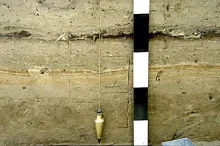
22. Ravi phase floors in section After excavation, the section view of the Ravi phase floors with agate manufacturing debris was drawn and photographed, and block samples were taken for micromorphological study. |
|
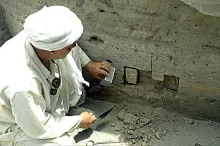
23. Sampling soil from the Ravi phase Blocks of soil removed from the Ravi phase section were taken to the University of Wisconsin, where they were impregnated with resin and sliced thin for microscopic analysis of cross sections of the… |
|
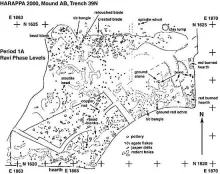
24. Mound AB, Trench 39N bead debris This plan shows concentrations of bead manufacturing debris on several superimposed Ravi phase floor levels that indicate the positions of actual work areas. |
|
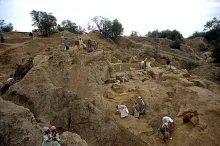
25. Kot Diji phase excavations Harappa Mound AB, Trench 39N, showing the Kot Diji phase (Period 2, ca. 2800-2600 BC) and later levels during excavation. The surveying tripod is standing next to two Kot Diji phase kilns, and the… |
|
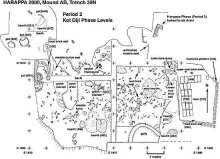
26. Plan of Kot Diji phase levels Plan view of Trench 39N Kot Diji phase levels (Period 2: 2800-2600 BC) with locations noted for major finds: sealing, elephant seal, inscribed sherds, limestone weight. This area appears to have been… |
|
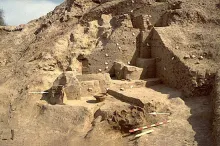
27. Kot Diji phase kilns Excavations in 1996 revealed two Period 2 small kilns for making figurines and bangles, as well as preserved floors with Kot Diji style pottery, beads, and figurines. |
|
28. Larger Kot Diji phase kiln The larger Kot Diji phase kiln, here shown under excavation, had a highly vitrified and reduced interior. |
|
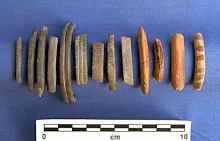
29. Kot Diji phase terracotta bangles Kot Diji phase terracotta bangles include many styles and incised and painted decorations. Grey bangles were produced in kilns with a reducing atmosphere and red bangles were fired in an oxidizing… |
|
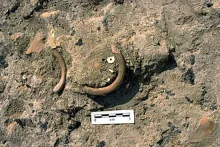
30. Kot Diji phase street debris The Kot Diji phase streets were filled with debris, including potsherds, charcoal, ash, animal bones, and occasional bangles and steatite beads. |
|
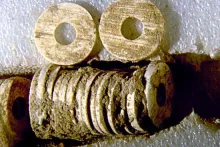
31. Kot Diji phase steatite disc beads This set of steatite disc beads, each about 1 cm in diameter, were found in the Kot Diji phase street and appear to be a necklace segment that was lost in the trash. The manufacturing marks are… |
|
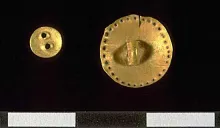
32. Kot Diji phase gold sequins Gold sequins found in the Kot Diji phase street suggest that some people were wearing clothing or paraphernalia decorated with rare and presumably costly materials. |
|
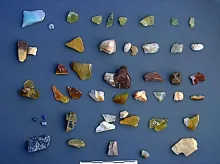
33. Kot Diji phase raw materials During the Kot Diji phase many new types of raw material were brought to Harappa for making ornaments and tools, indicating expanded trade networks and suggesting a growing population of consumers. A… |
|
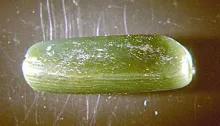
34. Green stone bead This unique green stone bead, hardly 1 cm long, was found in the ash at the edge of a Kot Diji phase hearth. The material has not yet been identified, but it may be a form of obsidian. |
|
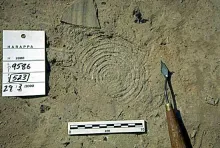
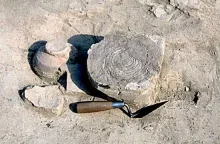
35. Kot Diji phase coiled basket impression Careful excavation resulted in the finding and preservation of this Kot Diji phase coiled basketry impression. |
|
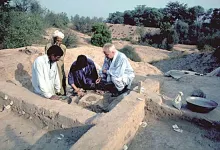
36. Block removal of basket impression Sediment around the basketry impression was cut away by graduate student Brad Chase, leaving it on a pedestal so it could be removed in a block. |
|
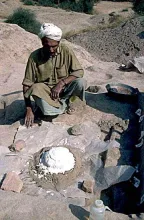
37. Basket impression and ceramic vessels In preparing the basketry impression for removal, large numbers of broken Kot Diji phase ceramic vessels were uncovered, all discarded together into the street along with the basket. |
|
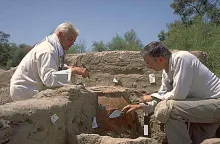
38. Plaster jacketing basket impression The pedestaled basketry impression was covered with plastic and a plaster jacket applied to hold the column together when the sediment was cut loose. |
|
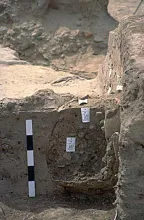
39. J. Mark Kenoyer and Richard Meadow HARP co-directors J. Mark Kenoyer and Richard Meadow discuss the excavation of a Kot Diji phase storage jar that was later covered by a hearth. |
|
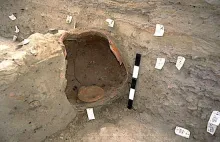
40. Fill of Kot Diji phase storage jar Careful excavation of the contents of the Kot Diji phase storage jar revealed a treasure of garbage that can tell us about the food the Kot Dijian people ate and discarded. |
|
41. Kot Diji Charcoal Dating At the bottom of the Kot Diji phase storage vessel was a broken lid and charcoal that was used for dating the fill inside the pot. There is a 91 percent chance that the date obtained from this… |
|
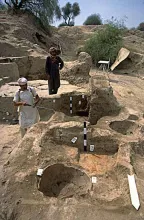
42. Kot Diji phase street Numerous pots and hearths were discovered in mud-brick buildings along the western edge of the N-S oriented Kot Diji phase street. |
|
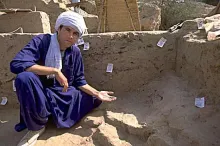
43. Finding Kot Diji phase button seal In Kot Diji phase sediment that had washed into the street, Brad Chase discovered a button seal (close-up in 44) quite similar to seals recovered from the site of Rehman Dheri in to the Northwest in… |
|
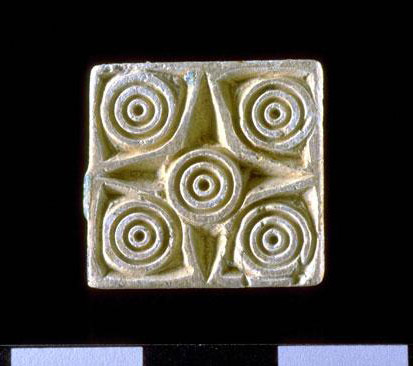
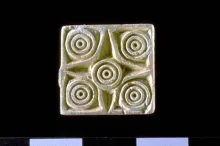
44. Glaze on Kot Diji phase button seal On this Kot Diji phase steatite button seal from Harappa (H2000-4495 / 9597-01), traces of blue-green glaze can be seen (upper center and left center). Similar seals have been found at other Kot Diji… |
|
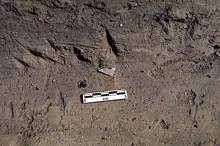
45. Kot Diji phase steatite seal in situ Along the eastern edge of the Kot Diji phase street on Mound AB at Harappa, a broken unfinished steatite seal was discovered in 2000 (close-up in 46 and 47). |
|
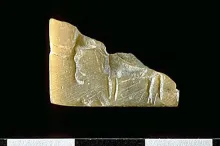
46. Kot Diji phase elephant seal - obverse Obverse of an unfinished elephant seal (H2000-4474/8994-01) in steatite from the Kot Diji phase levels at Harappa. This is the earliest seal with an elephant motif known from the region and may have… |
|
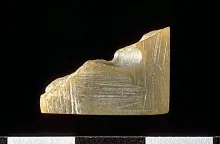
47. Kot Diji phase elephant seal - reverse View of the reverse of the elephant seal (H2000-4474/8994-01) from the Kot Diji phase levels, shows manufacturing marks and traces of a perforated knob or boss that is characteristic of Early… |
|
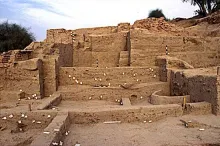
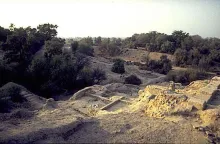
48. Kot Diji & Harappa phase levels Overview of Harappa Mound AB, Trench 39N, showing the Kot Diji phase levels in the foreground and the Harappa phase levels above, beginning with a baked brick drain (on the far left) and ending with… |
|
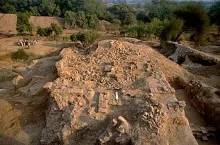
49. Kot Diji & Harappa phase levels North end of Harappa Mound AB, looking down on the Kot Diji phase levels from the heights above the Harappa phase baked brick wall (on the right) that has been covered with protective plaster for… |
|
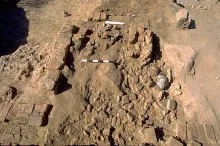
50. Harappa phase building remains Top of the northern end of Harappa Mound AB. Brick robbing has removed all of the large walls of substantial Harappa phase buildings, leaving the massive void visible on the right. Smaller divider… |
|
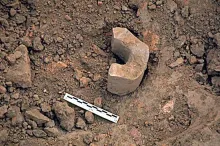
51. Rubble paving and Ringstones A paving of brick rubble and broken ring stones, dating to late in the Harappa phase, was found on top of Mound AB to the west of the wall void shown in 50. |
|
52. Harappa phase ringstone fragment A wavy ringstone fragment was found in erosion debris near the rubble leveling shown in 51. |
|
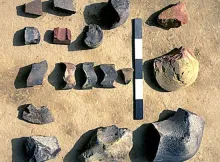
53. Broken Harappa phase ringstones Different sizes and colors of ringstones from upper Harappa phase levels of Mound AB, Trench 39N. The smaller rings may have been used to make decorative columns while the larger ones were… |
|
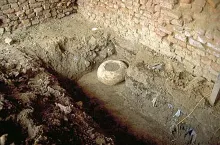
54. Ringstone in Harappa town This Harappa phase ringstone was originally found many years ago while local residents were digging a well in Harappa town. After some time it ended up at a house in Harappa town where it eventually… |
|
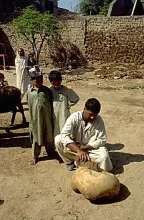
55. Cleaning the complete ringstone Excavation assistant Abdul Jabbar from Harappa town begins cleaning the ringstone after excavation. |
|
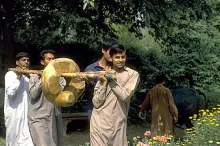
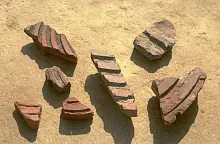
56. Carrying the complete ringstone Laboratory assistants Mohammad Naim, Shokat Ali, Said Ahmed, and Mukthar Massih carry the cleaned and conserved ringstone to the Harappa Museum for display. |
|
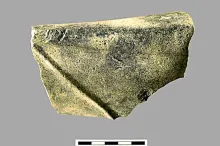
57. Enigmatic sandstone objects Fragments of a grooved red sandstone object or objects were found in the upper disturbed levels of Mound AB, Trench 39N. Similar fragments were recovered in the excavations by Rai Bahadur Daya Ram… |
|
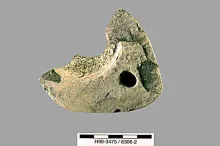
58. Stone sculpture fragment Carved stone fragment of what may be the leg of a composite sculpture, possibly of a large bull. This fragment came from Mound AB, Trench 39N (H98-3475 / 8306-2). No monumental sculptures of the… |
|
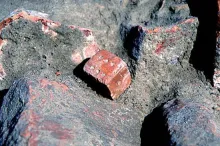
59. Stone sculpture fragment - another view Top view of the carved stone sculptural component (58) showing dowel hole for attachment to the rest of the sculpture. |
|
60. Harappa phase die A cubical die with 1 to 6 dots was found in the Harappan phase rubble. |
|
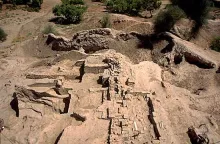
61. Harappa phase structural remains Overview of the north-south oriented brick wall (Feature 50) and doorway of the large Harappan building in Trench 39N. Note the earlier drain that runs east-west underneath the wall. |
|
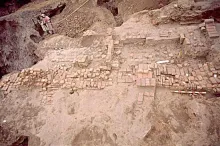
62. Harappa phase brick wall remains The brick wall may have been the foundation for a wooden superstructure and the white tags show where wooden posts were fixed. The doorway and threshold are located on the right side of the… |
|
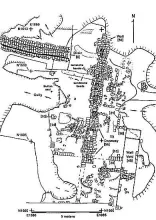
63. Plan of Harappa phase remains Plan view of Trench 39N Harappa phase levels with locations noted for some finds including the ring stones, terracotta beads, and sandstone beads. The baked brick drain (Feature 8) probably dates to… |
|
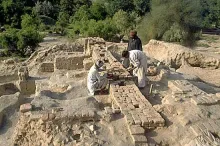
64. Conserving Harappa phase remains The original excavated structure here is being buried beneath a protective layer made from salvaged ancient Harappan bricks. A distinct layer of modern clay and straw plaster separates the original… |
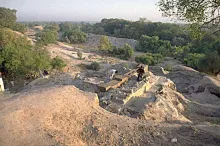
|
65. Harappa phase wall after reconstruction The reconstructed brick wall is covered each year with a protective coating of clay and straw plaster. The original structure and unexcavated levels remain safely buried beneath a layer of bricks and… |
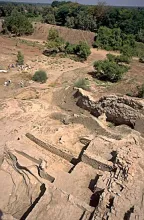
|
66. Harappa phase drain from above A portion of a large brick drain (Feature 8) was discovered beneath the Harappan wall (see Image 63). This drain runs E-W and would probably have emptied into a larger N-S drain that flowed to the… |
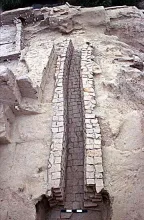
|
67. Harappa phase baked brick drain Brick robbing from both directions removed all but the central portion of this drain, but the remaining contents provide an important sequence of Harappan pottery spanning at least 200 years from… |
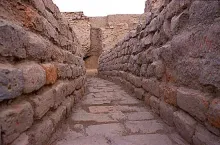
|
68. Inside of the Harappa phase drain This view along Drain [8] into the mound shows details of the brick construction, the robbed out area at the east end of the drain (background), sloping strata above indicating the existence of an… |
|
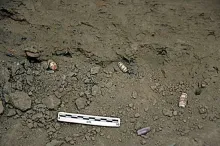
69. Harappa phase banded beads in situ In the street levels above the drain a collection of banded sandstone and banded terracotta beads were discovered. |
|
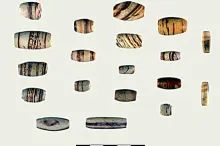
70. Harappa phase banded beads Banded sandstone beads and (bottom row) imitation stone beads made of different colors of clay. |
|
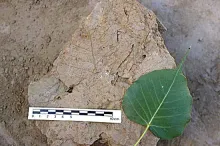
71. Pipal leaf impression The impressions of a pipal leaf found in the upper clay levels of the drain (shown here with a modern pipal leaf) indicate that what many think was a sacred tree even at that time was growing in the… |
|
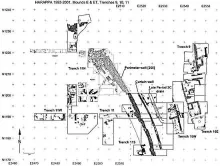
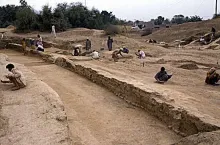
72. Harappa 1993-2001 Mound E/ET plan Plan view of the east side of Mound E and the west side of Mound ET showing areas excavated between 1993 and 2001 (Trenches 9, 10, 11). The massive perimeter wall of Mound E encloses architectural… |
|
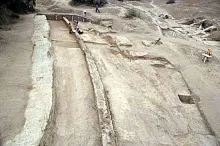
73. Mound E excavation Workmen are cleaning the Trench 11 area in preparation for photography during the 1997 excavation season. Perimeter wall [250] is on the left. The curtain wall in the center was constructed to retain… |
|
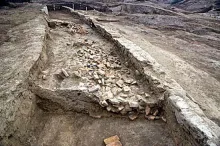
74. Trench 11 excavations The Trench 11 area showing the perimeter wall (on the left), the curtain wall, and the Period 3C drain that cut deeply into the Period 3B deposits (see the labeled plan in 72). The sediments outside… |
|
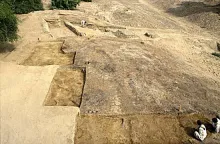
75. Building debris and rubbish Deposits of building debris and household rubbish were discarded over the perimeter wall into the open area below and were retained by the curtain wall. This infilling probably took place toward the… |
|
76. Harappa phase ashy debris deposits Ashy debris deposits continued to accumulate outside of the perimeter wall, covering the curtain wall. These date to the end of Harappa Period 3B and the beginning of Period 3C. The area continued to… |
|
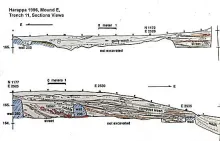
77. Cross-section through debris deposits Cross-sections inside (top) and outside (bottom) of perimeter wall [250]. The wall itself, being of mud-brick, was heavily eroded, sometimes to a lower elevation than the adjoining more densely… |
|
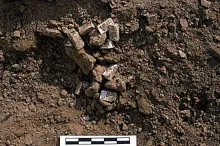
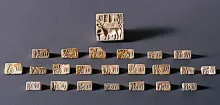
78. Group of incised baked steatite tablets A group of 16 three-sided incised baked steatite tablets, all with the same inscriptions, were uncovered in mid- to late Period 3B debris outside of the curtain wall. (See 56). These tablets may… |
|
79. Life and death of Harappan seals and tablets An additional six copies of these tablets, again all with the same inscriptions, were found elsewhere in the debris outside of perimeter wall [250] including two near the group of 16 and two in… |
|
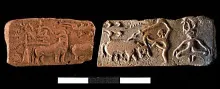
80. Indus narrative tablets Although neither of these specific molded terracotta tablet pieces comes from Trench 11, four less well preserved examples from the same mold(s) were found in debris outside of the perimeter wall in… |