
Harappa 2000-2001
The Early City on Mound E, a Bead and Tablet Workshop and the City Walls on Mound E. By Jonathan Mark Kenoyer and Richard H. Meadow.

|
1. Changing Settlement at Harappa The earliest settlement, during Period 1 (c. 3300-2800 BC), was on the west side of Mound AB and NW corner of Mound E. During Period 2 (c. 2800-2600 BC) all of Mounds AB and E came to be occupied,… |

|
2. Harappa Mound E Panoramic view of Mound E with modern Harappa town at the far left. In the center are excavation areas from 1987-1990. At the right is the area of Trench 54, excavated in 2000, that exposes the… |

|
3. Harappa Mound E surface collecting Excavations in 2000 on the west side of Mound E (Trench 54) began with surface collecting to recover any significant artifacts including inscribed objects and craft indicators. |

|
4. Terra cotta seal and faience tablets High concentrations of objects such as these terra cotta seal and faience tablets indicate the significance of this part of the site (Trench 54 area) for obtaining further insights on the manufacture… |

|
5. Tablet with man-in-tree and tiger Molded terracotta tablet (H2001-5075/2922-01) with a narrative scene of a man in a tree with a tiger looking back over its shoulder. The tablet, found in the Trench 54 area on the west side of Mound… |

|
6. Elephant faience tablet Faience tablet (H2000-4387/2089-02), found during surface collecting, depicts an elephant on one side and has script on the reverse (not shown). |

|
7. Faience button seal A faience button seal with geometric motif (H2000-4491/9999-34) was found on the surface of Mound AB at Harappa by one of the workmen. |

|
8. Early levels of the Harappan city After surface collections, the Trench 54 area of Mound E was selected for excavations because it allowed the exposure of a large area of the earliest levels of the ancient Harappan Period city,… |

|
9. Richard Meadow photographing Richard Meadow photographs the excavations in Trench 54 from a tall bamboo ladder that is supported by four ropes. This ladder can be situated over any area of the excavations to obtain near vertical… |

|
10. Protecting mud brick walls After mapping and photography, the fragile mud brick walls of Trench 54 are covered with a protective layer of burlap and sifted soil to form a sacrificial layer in which dissolved salts can dry and… |

|
11. Pottery fragment with sunburst In one of the rooms uncovered in Trench 54, a pottery fragment with a sunburst painted decoration was discovered that could be dated to the the beginning of the Harappan Period, perhaps as early as… |

|
12. Pit with kiln debris In what appears to have been an alley way between two blocks of buildings in Trench 54 was found a large pit filled with debris from pottery kilns. In the background is a room with a circular pit dug… |

|
13. Pottery sherds with potter's marks The pit filled with kiln debris in Tench 54 had in it sherds from ceramic vessels with marks inscribed on their bases before firing and also from a flat inscribed disc or "bat" (at left) that was… |

|
14. Pottery bat with inscriptions This pottery bat from Trench 54 at Harappa has pre-firing inscription on the underside, inside a ring base that would have allowed the bat to be centered snugly on top of the wooden head of a potter… |

|
15. Flat pottery discs Flat, uneven, pottery discs used as baffles in the firing process were found in the pit with kiln debris from Trench 54 (slide 12). Two of these, broken during the firing of the kiln, bear the foot… |

|
16. Copper razor A copper razor (H2000/2164-01) was found in the debris layers at the edge of the kiln dump in Trench 54. Wrapped with fibers, pseudomorphs and impressions of which are preserved in the in the… |

|
17. Fragment with fabric impression A terracotta fragment with fabric impression from Trench 54 provides clues on the types of weaving carried out by the ancient Harappans. |

|
18. Beads found in room A banded agate bead (at left), a long terra cotta bead (center) and a cylindrical steatite bead (at right) were all found in the deposits of a room in Trench 54. |

|
19. Different types of beads The ancient Harappans went to great efforts to obtain exotic colored stones for making beads of different shapes and sizes. |

|
20. Carnelian beads with white lines This carnelian bead has been artificially colored with white lines and circles using a special bleaching technique developed by the ancient Harappans. |

|
21. Wild caper trees The new green shoots of the thorny wild caper trees of Sindh and Punjab can be crushed with alkaline salts to create a paint-like substance that will bleach white lines on carnelian when heated to… |

|
22. Mark Kenoyer paints designs Attempts at replication of ancient techniques through modern experiments (experimental archaeology) is an important part of research at Harappa. Here, J. Mark Kenoyer paints designs on carnelian… |

|
23. Steatite button seal Fired steatite button seal with four concentric circle designs from the Trench 54 area (H2000-4432/2174-3). |

|
24. Unicorn sealing Low fired sealing in terra cotta of a unicorn seal from the Trench 54 area (H2000-4453/2174-192). This type of clay sealing was used to seal bundles of goods for transport. |

|
25. Faience tablet or standard This unique mold-made faience tablet or standard (H2000-4483/2342-01) was found in the eroded levels west of the tablet workshop in Trench 54. On one side is a short inscription under a rectangular… |

|
26. Tablet with script Mold-made faience tablet with script found in the eroded surface debris of Trench 54 (H2000-4484/2227-15). |

|
27. Tablet with inscription Twisted terra cotta tablet (H2000-4441/2102-464) with a mold-made inscription and narrative motif from the Trench 54 area. In the center is the depiction of what is possibly a deity with a horned… |

|
28. Two steatite tablets Two inscribed and baked steatite tablets from the Trench 54 area. One has the shape of a fish (H2000-4452/2174-191), while the other has a fish sign inscription (H2000-4477/2227-11). |

|
29. Inscribed fragment Inscribed lead celt or ingot fragment from the Trench 54 area (H2000-4481/2174-321). The object was apparently chiseled to reduce its size. Lead may have been used as an alloy with copper, for making… |

|
30. Gold bead Composite gold bead with copper-alloy core or wire on interior. The corroded copper still covers part of the tubular gold bead. (H2000-4488/9829-01, Mound AB, Trench 43). |

|
31. Gold button A button or sequin made of thin gold foil with a small interior loop for attachment to clothing. This piece was found crumpled into a small wad, possibly in preparation for remelting to make a new… |

|
32. Gold bead collection A collection of gold beads, three of which (UL, UR, LL) have copper-alloy in their interiors. The corroding copper often breaks the softer gold foil (Mound E, Trench 54). |

|
33. Two gold beads These two gold bead were originally part of the same ornament. Thin gold foil was placed over the outside of a sandy core around a copper tube (H2000-4382/2087-02, Mound E, Trench 54). |

|
34. Tiny gold droplet This tiny droplet of gold appears to be a placer nugget, possibly obtained by panning for gold. (H2000-4410/2102-08, Mound E, Trench 54). |

|
35. Black basalt pebble A black basalt pebble found in the excavations in Trench 54 has a few faint traces of gold colored streaks that may indicate it was used as a touchstone. Pure gold has a strong yellow-orange streak,… |

|
36. Faience cloven hoof Tiny cloven hoof made of two-color faience probably from a composite figurine. This cloven hoof could represent any number of animals, but the most common in the Harappan artistic repertoire are… |

|
37. Terra cotta dog figurine Terra cotta figurine of a dog with a projecting collar. This type of collar is today often used on fighting dogs to protect their throats (H2000-4968/2165-52, Mound E, Trench 54). |

|
38. Coiled wire necklace This unique discovery of a coiled copper-alloy wire necklace (H2000/2242-01) has traces of fibers preserved on the inside. Recent studies indicate that the fibers are from the wild silk moth,… |

|
39. Fiber pseudomorphs Fiber pseudomorphs preserved by copper salts on the interior of the coiled copper necklace (Slide 38) have been analyzed using various techniques and determined to be silk from the wild silk moth,… |

|
40. Terra cotta pestle A terra cotta pestle that may have been used for sanding wooden planks was found discarded along with broken pottery in an early Harappan Period 3B deposit in Trench 54. |

|
41. Steatite bead blanks A high concentration of tiny steatite bead blanks was found on an ashy floor near the kiln dump in Trench 54. Each (modern) bamboo piece is pointing at one bead. |

|
42. Unfinished steatite beads Hundreds of unfinished steatite beads were found in one small area an ashy floor in Trench 54. Some of the tiny wafers are perforated. |

|
43. Steatite sheets Thin sheets of steatite sawn from this blocklet found in Trench 54 would have been broken into small discs and then perforated. |

|
44. Experimental steatite manufacture Experimental manufacture of steatite beads helps us to understand the intricacies of the process. The thin wafers are perforated and then strung on a cord to grind and polish them prior to firing. |

|
45. Mullah Ashur grinding beads The technique for making tiny beads is still practiced by craftsmen today. Mullah Ashoor from Peshawar is seen grinding a string of tiny steatite beads that will later be fired to make them hard |

|
46. Trench 54 top plan Overall Plan of Trench 54, showing the location of features noted in the previous slides. |

|
47. Trench 54 section plan Section view through Trench 54. Note the location of the steatite bead-working dump. |

|
48. Trench 54 detail plan Detail top plan of the workshop for making steatite and faience beads and inscribed tablets in Trench 54 South. |

|
49. Trench 54 looking south Overview of Trench 54 looking south to the slope on the far side where the steatite and faience workshop was discovered. |

|
50. Broken faience beads Many broken and some complete faience beads of different colors were recovered in the eroded surface layers of the slope on the south side of Trench 54. |

|
51. Upper slope excavations After scraping the surface, excavations of the upper slope of Trench 54 South revealed scattered bricks and a terra cotta molded tablet. |

|
52. Terra cotta tablet Terra cotta tablet in situ (at tip of trowel) in Trench 54 South. |

|
53. Close up of terracotta tablet Close up view of molded terra cotta tablet (H2001-5061/2381-01) from Trench 54 South after cleaning, desalination, and conservation. |

|
54. Robbed brick wall and room The excavations of the lower slope area of Trench 54 South revealed a robbed brick wall void filled with rubble (foreground) and a room filled with manufacturing debris from faience and steatite… |

|
55. Highly trained excavators Mohammad Shamoon (black turban) and Abdul Sattar (flowered turban) are highly trained excavators who have worked with the Harappa project since 1986. Here they are carefully uncovering manufacturing… |

|
56. Indus steatite tablets Fragile steatite tablets are exposed under the skilled hands of trained excavators using small pointed bamboo sticks and brushes. |

|
57. Mark Kenoyer photographing J. Mark Kenoyer using the bamboo ladder to get an overview of the excavation area in Trench 54 South. Photography is done using digital, film, and video cameras. |

|
58. Workshop area Composite overview of the steatite and faience workshop area in Trench 54 South taken using the bamboo ladder. Two images were pieced together on the computer to make this composite. North is to the… |

|
59. Randy Law documenting Randy Law, a graduate student from the University of Wisconsin - Madison assisted with the excavation and documentation of Trench 54 South. Here he is using a digital camera to take close up images… |

|
60. Triangulation The locations of all important artifacts from Trench 54 South were carefully mapped using standard triangulation methods supplemented by printouts of digital overviews. |

|
61. Tablet fragment with glaze Faience tablet fragment (H2001-5064/2373-01) with glaze still quite well preserved. The bright greenish blue glaze is usually not preserved on artifacts that have eroded from the Trench 54 South… |

|
62. Newly discovered steatite tablet Mohammad Sahmoon (left) and Saeed Ahmad with newly discovered steatite tablet and raw steatite block from Trench 54 South. |

|
63. Unfinished tablet Unfinished and broken incised steatite tablet (H2001-5087/2934-01) found in the debris on the workshop floor in Trench 54 South. |

|
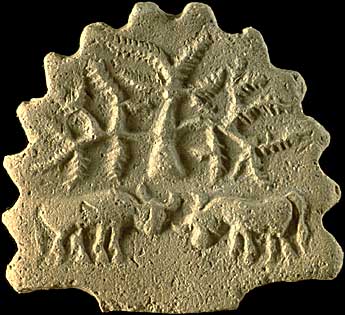
64. Broken steatite mold Broken steatite mold carved into a unique fan-shape. (H2001-5069/2913-02). This mold was probably used to make a faience tablet that was found on the eroded slope to the south of the workshop in… |

|
65. Molded faience tablet Fan-shaped molded faience tablet found on the eroded slope south of the Trench 54 South workshop. It was probably made using the steatite mold found in the workshop (Slide 64). |

|
66. Group of artefacts Artifacts found in one excavation unit from the Trench 54 South workshop include raw steatite, sawn blocklets, incised tablets, a broken mold, and numerous faience beads as well as faience tablets… |

|
67. Faience tablet Faience tablet (H2001-5082/2920-02) made from two colors of faience was found eroding from the Trench 54 South workshop area. Identical tablets made from two colors of faience were recovered in Area… |

|
68. Unique two colored tablet This uniquely shaped tablet (H2001-5090/2913-09), also made with two colors of faience, has an inscription similar to that seen on the previous slide (67). This tablet was found inside the workshop… |

|
69. Inscribed steatite tablets Inscribed steatite tablets made from two different colors of steatite have the same inscription. The sloppy nature of the inscription may be the reason why these tablets were discarded. Both tablets,… |

|
70. Grindstone and pestle A concave grindstone and angular pestle found in a room adjacent to the Trench 54 South workshop may have been used for grinding faience paste. |

|
71. Broken canisters Broken canisters, often with glassy vitrified surfaces, were found throughout the Trench 54 South workshop debris. Lumps of frothy faience slag with embedded fragments of bone were also quite common… |

|
72. Kiln setter Part of a terra cotta kiln setter found in the Trench 54 South workshop debris. The tip is not vitrified and may have been buried in ash during the firing process. |

|
73. Glazed kiln setter with bone A glazed terra cotta kiln setter with bone fused onto the splayed surface appears to have been an important part of the firing process in the Trench 54 South faience workshop. |

|
74. Reconstruction of tablet manufacture Experimental efforts to manufacture and fire faience and steatite tablets were undertaken by J. Mark Kenoyer in Madison, Wisconsin, during the summer of 2001. |

|
75. Stages of faience tablet manufacture Stages in the manufacture of faience tablets. First it is necessary to make the faience paste and the steatite molds. Then the paste is formed into a rectangle and impressed on both sides by the… |

|
76. Glazing faience In order to glaze faience it must be fired at approximately 940 degrees Celsius for several hours. The red color of the glowing faience barely visible inside the canister indicates that this… |

|
77. Glazed faience tablets Fully and partially glazed faience tablets and other fired objects could be examined after the fire had cooled and the canister opened. The steatite molds were also included in the canister to see… |

|
78. Workshop excavation units Section view of the the floor levels of the Trench 54 South workshop showing major excavation units. |

|
79. Section drawing Section drawing of stratigraphic layers in the upper part of the Trench 54 South faience and steatite workshop. |

|
80. Trench 54 perimeter wall View of excavations on the west side of Trench 54 where brick robbers had removed several massive Harappan Period baked brick walls (c. 2600-1900 BC, Harappa Period 3). At the bottom of the brick… |