
Around the Indus in 90 Slides 2
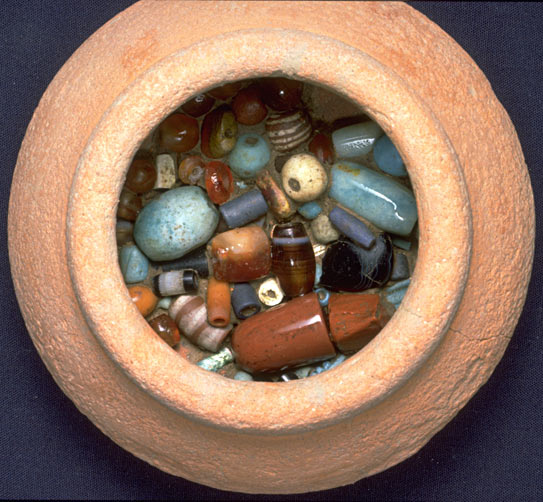
The Latest Discoveries at Harappa 1995-1998 include the earliest Indus writing, a 133 bead pot, 16 tablets, and more.
By Richard H. Meadow and Jonathan Mark Kenoyer and based on work by the Harappa Archaeological Research Project (HARP) of which they are Co-Directors.

|
1. Interaction networks of the Ravi Phase Arrows extend from Harappa to likely source areas for raw materials such as agate, lapis lazuli, steatite, marine shell and copper. These raw materials were transformed into ornaments and tools at… |

|
2. Map of Harappa archaeological site The excavation map is defined by the Harappa Archaeological Research Project, and shows the extent of occupation phases during different chronological phases. The major excavation areas featured in… |

|
3. Trench 39 South Excavations in Trench 39 South on Mound AB in 1996 revealed an extensive deposit of the Kot Diji phase occupation dating to between 2800 and 2600 BC. A geometric button seal (38) was found in the… |

|
4. Harappa Excavation team J. Mark Kenoyer (top center, arm outstretched) and excavation team gather at the edge of Trench 39 South at the end of the excavation season. Over the past twelve years many of the local workmen from… |

|
5. Harappa Trench 39S Looking up from the bottom of Trench 39S one can see habitation levels spanning over 500 years from approximately 3300 BCE at the bottom to 2800 BCE at the top. The white arrow pointing north is… |

|
6. Trench 39 North Excavations Excavations on Mound AB in 1998 began with the clearance of surface debris to expose the many habitation levels, beginning with natural soil in the lower foreground. This view shows almost 1700 years… |

|
7. Harappa Excavation Crew The 1998 excavation crew of the Harappa Archaeological Research Project. Seated at the front left are Mohammad Afzal Khan, representative of the Department of Archaeology, Government of Pakistan, Dr… |

|
8. Ravi Phase Pit During the Ravi Phase (circa 3300-2800 BCE) the earliest inhabitants lived in huts made of wooden posts probably covered with reeds and clay. They stored grain and other foodstuffs in small bell… |

|
9. Ravi Phase Floor Excavations in Trench 39 South 1996 uncovered the floor of a house dating to the Ravi Phase (circa 3100 BCE). Many complete vessels were found sitting on the floor along with broken necklaces, bone… |

|
10. Ravi Phase Pottery Fragments All pottery from the first part of the Ravi Phase was hand built. Most of the forms were finely made shallow bowls, deep bowls, narrow-mouthed carinated vessels, or thick walled cooking pots. |

|
11. Hand-built Pot Dating to c. 3100 BCE, this hand-built pot with polychrome decoration is one of the earliest examples of intersecting circle motif in the Indus valley region. This motif along with others, such as… |

|
12. Ravi Phase Motifs Whereas many other motifs of the Ravi Phase (Period 1) disappear in the later Kot Diji Phase (Period 2), the intersecting circle and fish scale motifs continued to be used, but they came to be… |

|
13. Master Potter Mohammad Nawaz, master potter from Harappa, demonstrates how fish scale and intersecting circle motifs may have been painted onto Harappan pottery. Here he is demonstrating at the Elvehjem Museum of… |

|
14. Ravi Phase Pot This Ravi Phase hand-built pot with polychrome design was found next to the one with intersecting circles illustrated earlier (11). The net and bird motifs are found at other sites to the northwest… |

|
15. Ravi Phase Cooking Pot Cooking pots during the Ravi Phase were made in large globular shapes that had a low center of gravity to keep them from tipping over when filled with food. In order to protect the fine clay from… |

|
16. Ravi Phase Pedestaled vessel Pedestaled vessels such as this hand-built painted bowl-on-stand of the Ravi Phase appear to be the predecessors of a vessel form that becomes more common during the later Kot Diji and Harappa Phases. |

|
17. Harappa Potters Mohammad Nawaz (center) and Zaman (right) holding replicas of hand-built Ravi style pottery. Bashir on the left holds an original Ravi bowl-on-stand that dates to around 3300 BCE. |

|
18. Terra cotta bull figurine This figurine is from Early Harappan (Period 2, Kot Diji Phase) levels at Harappa. The legs on are joined together, and along with the highly stylized hump, delicate horns and tail, are… |

|
19. Female Figurines Early Harappan (Kot Dijian Phase, Period II) female figurines are often broken. On the left is the lower half of a figurine, showing wide hips and pointed legs. On the right is the upper half of a… |

|
20. Figurine Early Harappan female figurine holding a bowl in her two hands. The face is painted with bold eyes and a necklace with pendant beads is painted at the throat. The lower body is decorated with cross… |

|
21. Terra cotta necklace find Conservators very carefully excavate and consolidate a necklace of terra cotta beads found in the Ravi Phase levels at Harappa in 1998. On the left is Arif Husain of Karachi University assisting… |

|
22. Terra cotta bead necklace This terra cotta bead necklace with two strands of long biconical beads dates to the Ravi Phase (c. 3300 BCE). |

|
23. Terra cotta beads Many different styles of terra cotta beads were made during the during the Ravi Phase at Harappa (circa 3300 BCE-2800 BCE). |

|
24. Textile Evidence The earliest evidence for normal weave textiles at Harappa is found in this impression on a Ravi Phase bead from Harappa, dating to around 3300 BCE. This fragment is only 1 cm long. Normal weave… |

|
25. Textile impressions Textile impressions on a toy bed made during the Harappan Phase (c. 2600-1900 BCE) show finely woven cloth made of uniformly spun threads. This example shows a fairly tightly woven normal weave. |

|
26. Bone tools Bone tools from the Ravi Phase levels at Harappa ( c. 3300-2800 BCE) include projectile points (top three objects), a bone awl that may have been used for making basketry (middle) and polished rib… |

|
27. Steatite bead necklace Fragments of a steatite bead necklace recovered from the floor of a house dating to the Ravi Phase (circa 3100 BCE, see 9). The beads have been fired and glazed. |

|
28. Steatite beads Steatite beads from the Early Harappan Periods at Harappa. On the right are many different styles of Ravi Phase beads (circa 3300-2800 BC). Note the blue green glazed bead in the center and the row… |

|
29. Ravi Phase beads These beads from the Ravi Phase (3300-2800 BCE) at Harappa have been made from carnelian and amazonite (right hand bead). The raw material used to make these beads was brought to the site from source… |

|
30. Small pot A small pot dating to the Period 3C of the Harappa Phase (c. 2200-2000 BCE) was found in excavations on Mound E in 1998. This tiny pot contained fired steatite beads similar to those made during the… |

|
31. Gold Disc Fired steatite beads appear to have been extremely important to the Indus people because they were incorporated into exquisite ornaments, such as this "eye bead" made of gold with steatite inlay… |

|
32. "Priest King" Forehead The central ornament worn on the forehead of the famous "priest-king" sculpture from Mohenjo-daro appears to represent an eye bead, possibly made of gold with steatite inlay in the center. |

|
33. Ancient Indus Jewellery Fired steatite was an important material used in many different types of Indus jewelry. Steatite beads are found in all four necklaces in the center of this collection of jewelry from Harappa and… |

|
34. Inscribed Ravi sherd The origins of Indus writing can now be traced to the Ravi Phase (c. 3300-2800 BCE) at Harappa. Some inscriptions were made on the bottom of the pottery before firing. Other inscriptions such as this… |

|
35. Kot Dijian Phase Symbols These particular symbols made on the bottom of terra cotta vessels prior to firing were probably made by potters during the Kot Dijian Period in order to identify their own vessels or ones being made… |

|
36. Inscribed mold fragment This fragment of a mold used for making large storage jars has three pre-firing graffiti signs. Such symbols when combined together may have served to indicate the name of the owner rather than just… |

|
37. Inscribed sherds Many sherds inscribed after firing have single geometric signs. This collection of Early Harappan sherds from Periods 1 and 2 (c. 3300-2800 BCE) show a range of geometric signs that are roughly… |

|
38. Button seal This fired steatite button seal from the Kot Dijian Phase (Period 2, 2800-2600 BCE) shows a unique pattern that may be an early form of the Harappan script sign that may represent "house" or "temple… |

|
39. Button seal find The discovery of a button seal is always exciting. Mushtaq, one of the excavation assistants from Harappa Town is proud to have found the second seal of the 1998 excavation season. |

|
40. Button seal Button seal from the upper layers of Mound AB. Although this seal was found in mixed deposits dating to the Harappan and Late Harappan Periods, the carving suggests that it is actually an Early… |

|
41. Inscribed sherd, Kot Dijian Phase This sign was carved onto the pottery vessel after it was fired and may indicate the type of goods being stored in the vessel or the owner of the vessel itself. Another possible explanation is that… |

|
42. Sherd with signs On some sherds, two signs of the Early Indus script (Kot Dijian Phase) appear together. The complete shapes of these signs can be seen on later seals carved with the Indus script (see 43). The sign… |

|
43. Unicorn seal A steatite unicorn seal from Harappa with Indus script. This seal was found in the central area of Mound E and dates to Period 3B or early 3C, around 2450-2200 BCE. When pressed into clay the… |

|
44. Inscribed rim sherd Three signs are inscribed on this rim sherd of the Early Harappan Period (Kot Dijian Phase), dating to around 2800 BCE. Two of the signs appear to be pictographs for a bow and arrow, but they… |

|
45. Inscribed storage jar Many large storage jars of the Harappa Phase (2600-1900 BCE) have writing inscribed along the upper portion of the vessel. This inscription includes a figure of a man with the bow and arrow sign in… |

|
46. Sealing find One of the most exciting discoveries of the 1998 excavation season was finding a seal impression or sealing in a hearth of the Early Harappan Period (Kot Diji Phase, circa 2800 BCE). Here William… |

|
47. Seal impression This Early Harappan seal impression or sealing of a square seal has several script signs and two ladder like motifs (Kot Diji Phase, c. 2800 BCE). The wet clay was probably placed on a bundle of… |

|
48. Three clay sealings Three clay sealings from the Harappa Phase levels (2600-1900 BCE) that may have come from large bundles of goods shipped to the site from a distant region. The clay does not appear to be the same… |

|
49. Raw Materials and Trade Networks This map shows raw material distributions in the Indus Valley and adjacent regions. The extensive trade networks of the Harappan Period (2600-1900 BCE) linked distant resource areas to the major… |

|
50. Eastern edge of Mound E A large number of seals and inscribed objects were discovered in excavations on the eastern edge of Mound E from 1993 to 1997. This view of excavations in Trench 10W shows two rooms of houses along… |

|
51. Trench 11 Excavations in 1998 expanded the area of Trench 11 which lies to the west of Trench 10 on Mound E in order to recover seals and inscribed objects inside actual houses. Richard Meadow (HARP Project… |

|
52. Molded tablets Molded tablets from Trench 11 sometimes have impressions on one, two, three or four sides. This group of molded tablets shows the complete set of motifs. One side is comprised entirely of script and… |

|
53. Eastern edge of Mound E Clearing the ancient Harappan debris from the eroded surface outside of the mud brick city wall at the eastern edge of Mound E. In 1997 this area of Trench 11 was cleared to define the stratigraphic… |

|
54. City Wall The curving line of the mud brick city wall at the eastern edge of Mound E rose high above the level of an ancient street that followed the exterior of the wall. A small apron or divider wall made of… |

|
55. Unicorn seal A square steatite unicorn seal with a unique inscription was found in the street debris on the inside of the city wall. The two sets of signs on the right hand side of the seal would appear in… |

|
56. Sixteen three sided tablets Sixteen three sided tablets (c. 2300 BCE) with incised inscription on each face were found all together in the debris that had been dumped over the curtain wall (54). On one of the three sides is an… |

|
57. Electron Microscope analysis Scanning Electron Microscope analysis of the incising marks on the steatite tablets indicates the use of three different specialized bronze graving tools (see 58). Each tablet was first shaped from… |

|
58. Electron microscope analysis For the second group of tablets the leading edge of the incision is more rounded and there are grooves along the wide slope of the cutting angle. The third type of tool is equally distinct. When… |

|
59. Three groups of tablets Three groups of tablets can be defined on the basis of the type of tool used to incise them and the style of inscribing. The most complex script sign appears to have been made with different numbers… |

|
60. Stroke direction The red arrows indicate the direction of strokes used to incise each group of tablets. |

|
61. Two inscribed tablets These two inscribed tablets (c. 2300 BCE) have the same inscription, but it was written in opposite directions. What is even more interesting is that the top tablet is incised with the same … |

|
62. Inscribed sherd, Harappa Phase Most inscribed sherds are part of larger vessels that were inscribed and then broken. This object (c. 2300 BCE) was inscribed as a sherd. It is clear that broken sherds were occasionally used as a… |

|
63. "Granary area" Limited excavations in the granary area at Harappa starting in 1997 (Trench 41 area) and 1999 have begun a new examination of this important building, first excavated in the 1920s. Although referred… |

|
64. Unicorn seal Unicorn seal from Trench 37, which lies to the east of the "Granary." This type of seal comes from levels dating to Harappa Phase Period 3B. Similar seals were found near the "granary" in 1997. |

|
65. Harappa Trench 39 North Overview of Trench 39 North, looking at the Harappan and Late Harappan Period levels. The brick wall is part of a large building that was constructed with wooden beams and columns. In the foreground… |

|
66. Long rectangular seal with no animal motif This type of seal is only found in the last part of the Harappan Phase, Period 3C. A similar rectangular seal was found on Mound F in the 1998 excavations of the circular platforms (Trench 43). |

|
67. Mound F, looking towards Mound AB The so-called circular working platform area and workmen's quarters are seen in the mid-ground. New excavations of a circular working platform was begun in 1998 and continues in 1999. Initial results… |

|
68. Circular platform In 1998, the circular platform first exposed by Sir Mortimer Wheeler in 1946 was re-exposed and the area around the platform was expanded to reveal the presence of the room in which it was enclosed… |

|
69. New circular platform To the west of Wheeler's circular platform a new platform was discovered. This platform was excavated using modern stratigraphic procedures and detailed documentation. Charcoal, sediment, animal bone… |

|
70. Seal Fragment Seal fragment of a man with double bun and three fingered hand or trident. Trench 39 North, upper levels, Harappa Phase. |

|
71. Major Sites and Interaction Networks This map shows the networks that connected urban centers such as Mohenjo-daro and Harappa during the Harppan Period (2600-2000 BC) with their hinterlands and distant resource areas.In addition to… |

|
72. Dish or lid Late Harappan Period dish or lid with perforation at edge for hanging or attaching to large jar. It shows a Blackbuck antelope with trefoil design made of combined circle-and-dot motifs, possibly… |

|
73. Dish-on-stand Late Harappan Period Dish-on-stand from Harappa with a hole in the center of the dish that may have been used for a special ritual purpose. The dish is pedestaled on a heavy base with triple ridges… |

|
74. Large burial urn Late Harappan Period large burial urn with ledged rim for holding a bowl-shaped lid. The painted panel around the shoulder of the vessel depicts flying peacocks with sun or star motifs and wavy lines… |

|
75. Three vessels Three vessels of the Late Harappan Cemetery H period (after 1900 BCE). In the center is a small painted globular pot from a burial group. These forms and their surface treatments are quite distinct… |

|
76. Excavation team Excavation of the Late Harappan Period habitation levels was undertaken by the Harappa Project in 1996 in Trench 38 under the direction of Manabu Koiso, Japan (front left seated with red turban) and… |

|
77. Cemetery H house Cemetery H house wall and floor level dating to around 1700 BCE Complete bricks used to make the wall indicates an active brick industry rather than the decline previously assumed. |

|
78. Trench 38 Beneath the Late Harappan wall in Trench 38 is a large globular pot covered with an inverted bottle shaped vessel that was used as a lid. This and the other small bowl protruding from the section… |

|
79. Small pot A small pot was found on the floor just to the west of the large globular vessel (the big hole in the wall is where it once sat). In the foreground are other large jars set into the floor and used as… |

|
80. Bead Pot Initial probing to determine the contents of this small pot (79) from Trench 38, Late Harappan Period, revealed the presence of carnelian and faience beads. |