
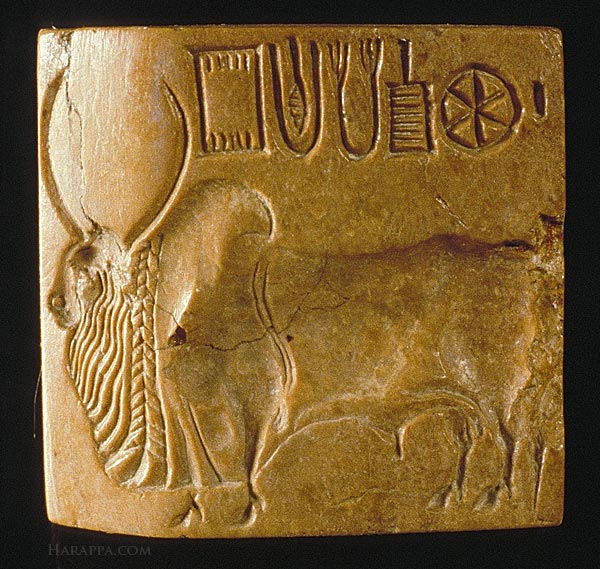
The majestic zebu bull, with its heavy dewlap and wide curving horns is perhaps the most impressive motif found on the Indus seals. Generally carved on large seals with relatively short inscriptions, the zebu motif is found almost exclusively at the largest cities of Mohenjo-daro and Harappa.
The rarity of zebu seals is curious because the humped bull is a recurring theme in many of the ritual and decorative arts of the Indus region, appearing on painted pottery and as figurines long before the rise of cities and continuing on into later historical times. The zebu bull may symbolize the leader of the herd, whose strength and virility protects the herd and ensures the procreation of the species or it stands for a sacrificial animal. When carved in stone, the zebu bull probably represents the most powerful clan or top officials of Mohenjo-daro and Harappa.
Harappa Archaeological Research Project.