
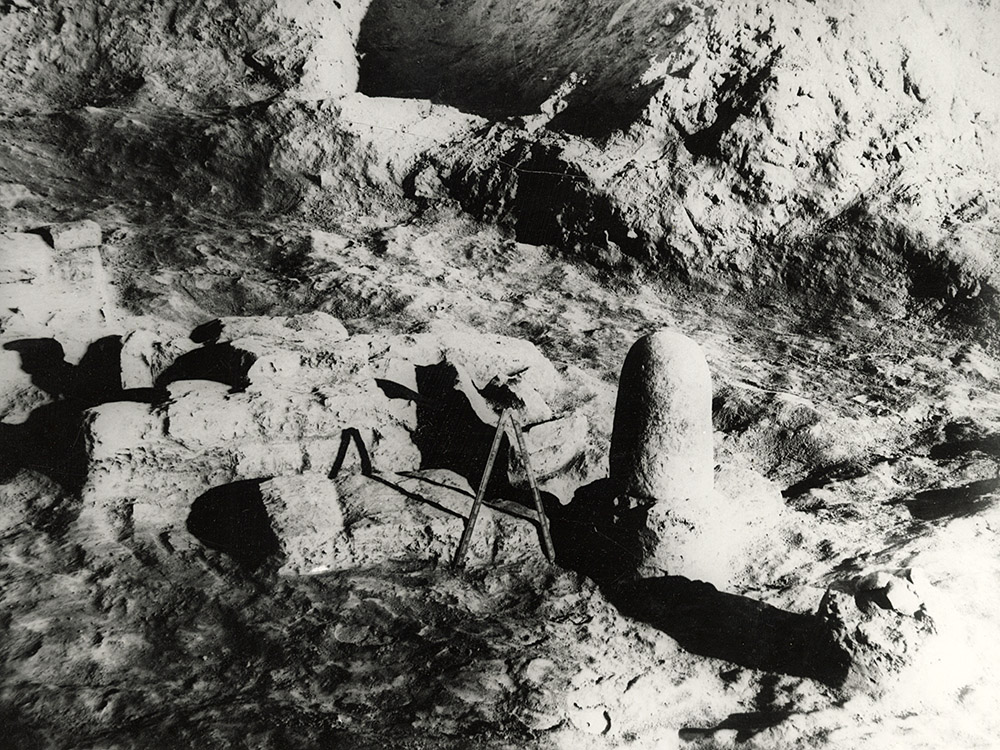
Published but cropped in ARASI 1924-25, Plate XXIV (e)
Captioned: ‘Harappa: Mound F, Stone Obelisk (height 11” Found in Trench A (i)’
The find was in “Trench Ai (100’ x 31’) and Sahni noted: “A little lower down, i.e., at the depth of 5’6” below the surface, was found an object of considerable interest, though its exact purpose is not yet apparent. It is a stone obelisk (height 11”, circumference 1’11”, Plate XXIV, e) resembling the Siva-linga. The lower portion of the cone has been left rough, thus indicating that it was originally fixed in a pedestal of some kind. The excavation was therefore continued and at a depth of about 2’ below the level of the cone I found the remains of a tiny brick structure with a very narrow entrance facing the south and with what might have been brick steps in front. The pedestal of the cone was not recovered, but it is not impossible that the stone obelisk was presented or installed for worship in this very cell.” [ARASI 1924-25, pp. 77-8]
Sahni mentioned this object also at the beginning of his narrative of the excavations at Harappa in 1924-25:
“The inhabitants of Harappa appear also to have been in the habit of offering their temples terracotta cones with or without figures of animals …. I am inclined to think that a large cone of dark stone, height 11”, (Plate XXIV, e) resembling the Siva-linga of modern times which came to light in trench A(i), must have been used for worship.” [ARASI 1924-25, p. 74]
Published in Vats 1940, Vol. II, Plate X (c). Title: ‘Lingam in situ in Trench Ai’.
Vats: “In the adjoining Trench Ai, 5 ft. 6 in. below the surface, was found a stone lingam (No. Ai 40, PI. X, c). It measures 11 in. high and 7 3/8 in. in diameter at the base and is rough all over”. (pp. 51-2).
In a footnote, no. 2, for the above Vats noted: “Since then I have found two stone lingams of a larger size from Trenches III and IV in this mound. Both of them are smoothed all over”. (p. 51)
- Vats, M.S. 1940, Vol. I, pp. 51-2.
Although captioned a stone obelisk in the published photograph in ARASI 1924-25, Sahni inferred the object to be a shiva linga.