

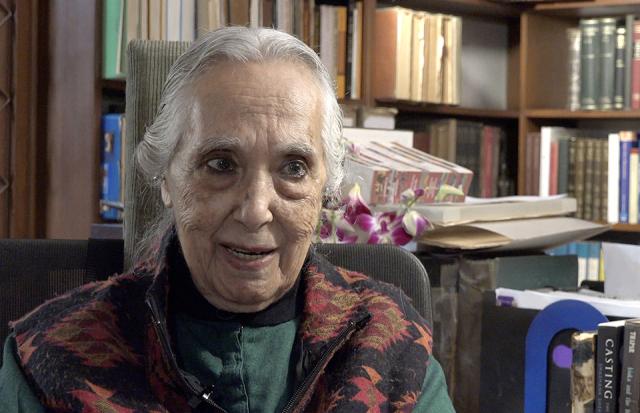
Dr. Romila Thapar was interviewed at her home in New Delhi on February 24, 2026 by Omar Khan and Dr. Sudeshna Guha, with Yousuf Saeed. Dr. Thapar was born in 1931 and is one of India's most distinguished historians, author of numerous books on early Indian history, and winner of the US Library of Congress Kluge Prize for lifetime achievement. This interview covers her early life in what was then British India, her work, visits to ancient Indus sites and historiography.
Omar: Where were you born and where did you grow up, and tell me a little bit about what your parents did?
Romila: That’s a lot of questions! Yes, alright, I was born in Lucknow in 1931. I grew up in what was then called, in the 1930s and early 1940s before Partition, the Northwest Frontier Province in the northwest of the subcontinent. My father, being a doctor in the army, tended to be posted from place to place every two or three years. So, we moved around from the frontier forts to Peshawar to Rawalpindi before he was transferred to Pune in 1942. Then there was a long stretch in Pune, which was very nice for me because otherwise it meant getting up and hopping around all the time. So that’s where I grew up.
My father, as I said, was a doctor in the army. From what I’m told, his first posting was in Lahore, which was of course the family place, as it were. My grandfather, who was a schoolteacher, Kunj Bihari Thapar, moved from Ludhiana, where he first had a job as a schoolteacher, to Lahore. That was the first move toward what was really the hub of culture and education, whatever was going on in the northwest. [Lahore] was sometimes referred to as the Calcutta of the Northwest because Calcutta was the hub in Bengal and eastern India. So, it was very much a major attraction for anybody.
He thought that school teaching would be great fun in Lahore, so he moved there with his wife, who was universally known as Manji. They had ten children, of which six survived. Two died fairly young, and two daughters died after bearing a few children. The other six had their own little families.
Omar: What memories do you have of Lahore as a young girl?
Romila: I have a very strong memory of the house. I did not know my grandfather because he died a couple of months before I was born, but I have a very strong memory of the house. My grandmother, was very much the matriarch, the boss of the show. Her three sons were completely under her control and did exactly what she asked them to do.
She had one sensible idea. It was a large, sprawling house and it had three rooms upstairs with suites—room, bedroom, dressing room, and bathroom. She said to her three sons, “Each of you take one, and every December I want you to come with your families and spend December here in Lahore because I want the cousins to grow up knowing each other.” One disliked it at that time. I remember, every end of November, my father would say, “Now we pack up and go to Lahore,” and I would say, “Oh God, not again.” But actually now it's the one thing that has really – knowing the cousins – has kind of cemented the family all over again as it were, and that was so nice. I remember that very well.
On the two or three occasions when I went back to Lahore for conferences and seminars, I used to always make it a point to visit the house. Later on, of course, the big grounds in the front were occupied by an apartment block that came up, and then I stopped going.
Otherwise, the usual kinds of things. I remember driving down the Mall Road, as it was called, and the big bookshop J. Ray & Sons, where we would all go and collect our little children’s books. From comics we graduated from reading children’s books too. I remember the last time I was in Lahore, which was in December 1946 before Partition. I went to J. Ray & Sons. I was 14 then, and I said, “I would like the complete works of Oscar Wilde.” Mr. Ray was rather upset by this and said, “I’m not so sure that you’re old enough to read Oscar Wilde.” We had a little argument, but he said, “No, no, you’ll come back next year”—not knowing, of course, that there would be no next year—and I might then give you a copy of Oscar Wilde.” That I do remember.
From there I moved on to various bazaars like Anarkali. There were other bazaars where we went shopping, buying cloth for making salwar kurtas and buying the occasional sari. Saris, of course, were not very commonly worn at that time. Most Punjabi women were still going around in shalwar kameez, as we called it.
Of course, there were shops that sold chaat and sweets. Sweets were very, very popular. There was one of my uncles in particular, whom we were all very fond of, because every time we said, “Uncle, let us go and have some ice cream,” he would say, “Yes, of course, I’ll take you to have some ice cream.” We’d all pile into his car, which was more like a truck, and we’d go down and have ice cream.
The bazaars were great fun. I liked that. I remember driving down to the Ravi River and eating freshly caught fish that were grilled on the spot. Little things like that stayed in my memory.
There was another little area where I was constantly told that this was where Amrita Sher-Gil lived and this was where the Shobha Singh family lived and every one knew Khushwant Singh. At that point, Amrita Sher-Gil was the only name that really registered with me. Nevertheless, it was an elegant little area quite close to the famous area of Lahore, which was Nisbat Road—the area to which every aspiring middle-class man looking for a good job would come, meet the right people, and then move into Model Town, which was a cantonment area.
And then there was Bradlaugh Hall, which was where the atheists used to meet, and that was also considered a big thing.
Sudeshna: How old were you then?
Romila: How old was I? Well, it started fairly early, but my early teens were the most memorable.
Sudeshna: I’m curious about one thing. You said you wanted to read Oscar Wilde. Where did you get that idea from?
Romila: I don’t know. Somebody mentioned it, I think somebody in school or maybe somebody out of school, and said something about, his poetry is so racy, it's fun to read. So, I decided that the next time I was in J. Ray–
Sudeshna: And you had siblings?
Romila: Yes, I had siblings. I had a sister who was 9 years older than me, and I had a brother who was 10 years older than me. I really didn't have the experience with siblings so much as a young person because they were in what was called boarding school. They were in boarding school because my father was up in the northwest frontier, and there were no schools there worth going to. So, I grew up almost as an only child until I was in my early teens. They would come home for vacation, of course, but that was different from having them around throughout the year.
So that was Lahore. I used to think earlier on that, you know, it was alright, but it wasn't a great place because there were aunts and uncles who would constantly come and say every year, “Oh, you've grown fatter, you’ve grown taller,” or “Your clothes are not fashionable enough,” or something. I would get really irritated with that.
The one time that I suddenly realized how important it [Lahore] had been was when I went back on one of those occasions to the [our] house. The very first time in the 1960s, there was somebody living there. It was part of what was called evacuee property. They saw me lurking around and came and said, “Where are you from?” I said that I remembered this house as a child. I lived here. They said, “Come in, come in,” lots of tea and lots of mithai. They took me from room to room and said, “Who was here? What happened here? Tell us the history of the house,” that kind of thing.
Then I came out and sat down, and there was this little culvert outside over the drain where our pet gunderiwala used to sit. He was a guy who would sit with a stack of sugarcane, cutting it into little pieces, gunderis. Every afternoon all the cousins would congregate there and say, “We want to have gunderis.”
I came out and sat on the culvert, and he was still there, a much older man now but the same man. He looked at me for about two or three minutes, and then he said, “Are you from India?” I said yes. He said, “And what brings you to this house?” I said we used to live here.
“Oh,” he said, “now which one are you then?” And he mentioned the names of all my little girl cousins whom he remembered coming there for gunderis.
I was overwhelmed with the nostalgia brought on from what he said. Of course, one of the things that happened after partition was that people built up this great mystique of the city of Lahore, how wonderful it was, and so on. It got bigger and bigger in one's imagination, and a lot of that played a role. Every time I went back to Lahore, those memories would come back, my childhood memories.
Omar: Where was your house in Lahore?
Romila: My grandparents first lived on Nisbat Road. Then they left when he stopped being a schoolteacher. He was picked up by the British administration because his English was rather good. He was told that he must do a summary of the vernacular press, as it was called—Hindi and Urdu —in English and pass it on, because they wanted to know what was being said, to know it that properly.
Then he slowly had a better salary, and they moved then and built a house on the corner of Golf Road and Racecourse Road. It was quite a sprawling sort of place, old-fashioned architecture but very pleasant. It had a huge lawn in the front, which is where they later built a multi-story building.
Omar: My grandfather lived on the corner of Lawrence Road and Queens Road, so I think not too far away.
Romila: Not too far away, yes. In fact, on a later occasion when I went back for a seminar, I think it was much later, 1998 I think it was, I was still surrounded by people after the talk who came up to me and said, “Oh, my great-grandfather knew your grandfather,” and that kind of thing. Old family histories were being brought out in this connection, and I realized that it really was a very closely knit society in those days. They were all in each other's pockets as it were.
Omar: How interesting. They're trying to return Sikhs to Lahore now. The number of Sikh families has gone up to about 150 or something. People are coming in from Canada and they're restoring temples and gurudwaras. Tell me about Peshawar a little bit, Romila, because you spent some time there.
Romila: We were first living in a place called the Thal Fort, which was a regular fort built by the British. We were observing the life of the fort. My father was the Chief Medical Officer attached to the regiment. He often used to go off and attend to the Pathan patients because they would call up and ask for help, and my father was the kind of go-between as the doctor attending to them.
That was great fun because my mother and I would travel with him to these areas and we would be taken off to the Zenana and meet all those beautiful Pathan women with their maroon and black ornis and silver jewelry. Loads of silver jewelry, lots of silver rings. My mother used to say to me later, when I grew up, that my love for silver rings came from the Pathan women whom you were kind of nurtured by on this kind of thing.
From Thal Fort he [my father] was then transferred to Peshawar. I remember Peshawar for three things. First of all, it was the first time I was in a regular school, not a play school as I had been earlier. I was in a regular school, I was then I think six or seven. There was a walk to the school every morning. The night watchman, the chaukidar, would walk me to school and then fetch me back at lunch time when school ended. He had lovely stories about ghosts and all kinds of other things and haunted that area of Peshawar which would terrify me. I would come back and say to my mother, “I am not going to sleep in that room alone because Rehman Khan said to me that there were ghosts running around the house.”
More importantly, one family and one person made a deep impression on me [in Peshawar]. One was that my father, when he returned from England, where he had trained in medicine at University of Edinburgh, he joined the volunteer corps that Gandhi had called for in World War I. He helped organize it together with Sarojini Naidu. So, there were those links.
He returned to India on a troop ship and shared a cabin with Dr. Khan Sahib, who happened to be the brother of Khan Abdul Ghaffar Khan, Badshah [also Bacha] Khan. So when my father was later transferred to Peshawar and looked up Dr. Khan Sahib, he became great friends with Badshah Khan as well.
One of my strongest memories is still of the great booming voice of Badshah Khan coming to the door of our house and shouting out. My nickname was Cuckoo, and he would call, “Cuckoo ki ma, chai banado! [Mother of Cuckoo, make some tea!].” My mother would rush out and make a cup of tea for him, and we would all sit there and he would sit me beside him and say, “Now what did you do at school today?” and that kind of thing. I just loved his words. There was something special about him that was so, so different from anybody else whom I knew.
The other [memory] was that next to our house was the house of the political agent of the British administration. This political agent happened to be a man called Sikander Mirza [also known as Iskander Mirza, later President of Pakistan 1956-58].
Omar: Did you know, Ghani Khan, Badshah Khan’s son?
Romila: No, I didn’t. I only knew Badshah Khan.
Omar: Tell us a little bit about Sikander Mirza because he was your neighbor, right?
Romila: He was the Political Agent. Now when I think about it, it’s absolutely incredible. Sikander Mirza’s family and we became very close friends. My mother was very fond of his wife, who was really a marvelous Persian woman. My father and Sikander got on very well because they shared the same sense of humor and they cracked the same jokes all the time, which was very nice.
They had six children. The closest to me in age was a lovely young girl, called Zeenat. I was absolutely inseparable from Zeenat because she was one of these gentle, soft-spoken people of my age. We became very firm friends. We went to school together, we would come back and meet in the evenings.
I remember the huge garden of the house of the Political Agent where we used to play hide-and-seek. Since they were six brothers and sisters, there was ample scope for a great deal of playing to go on. A lot of my time was just spent playing hide-and-seek in their big garden.
Zeenat was my very, very close friend, and I was absolutely heartbroken when my father, three years later, was transferred to Rawalpindi, and I had to part from her.
I met her again, many years later, in Karachi. She was staying with her sister Fakhri at the time. I was there to give the keynote address at the Oxford University Press Book Fair that was opening that year.
I mentioned that I had once been very close friends with Zeenat and would love to see her again, because someone said to me that what remained of the Sikander Mirza family was now settled in Karachi. They found out and found that Zeenat was there. She came to the dinner that evening, and we just fell into each other’s arms and chatted endlessly about old times. It was really lovely meeting her again, but we haven’t met since then of course.
Omar: So, what happened to your family at Partition?
Romila: My father was at that point posted in Delhi. I was in school in Pune, I was a boarder. I had a year to go before the Senior Cambridge examination, and I absolutely refused to change schools yet again, having changed four schools already.
My parents were in Delhi. I used to get little bits of news in my mother’s letters. Letters took nearly three weeks to arrive because everything was disturbed at that point. It was the day-scholars at school who would bring us news about what was happening in connection with 1947 and the Partition to come.
My father tells me that in the first week of August, my grandmother and her unmarried daughter arrived in Delhi from Lahore. They were all living in Lahore. They arrived with just one suitcase each. My father said, “What have you brought? Just one suitcase of clothing?”
They replied, “Yes, because everyone says this is a minor riot. It will die down soon, and we will all be back in Lahore in a month’s time.” That was the last they had seen of Lahore.
They stayed on [in Delhi]. Then my father was posted to Pune again. The rest of the family came over from Lahore. His two brothers were in Government service: one was in the Civil Service, he was posted initially I think to the Panjab, and finally to Shimla. The other brother was in the army and therefore was [posted] all over the place in India.
There were three sisters– one was of course looking after my grandmother, while the other two were married and their husbands had postings in the Panjab. So the family gradually scattered from Lahore. It was really only when Delhi developed and people started buying property to build houses in Delhi, that the family moved back [together]. Now the family is more or less coherent in Delhi, moving on to the third generation.
Sudeshna: I remember that you once told me that when your father was in the Northwest Provinces, that you had seen Shah-ji-ki-Dheri [a Kushan-period Kanishka stupa near Peshawar], the Buddhist site. when you were very young. Do you remember any of these old kinds of archaeological sites from the time when you were there?
Romila: Oh, very much. Takht-i-Bahi [a Buddhist stupa and monastery near Mardan], for instance. I can remember it almost piece-by-piece, the whole monastic complex. Partly because my father, who was no historian as such, was interested in old things. On occasion, over a long weekend he would take us on drives to these Buddhist sites.
I remember Taxila very well, because I went back repeatedly, and Shah-ji-ki-Dheri and other sites there.
Then, in 1998 I think it was, I went to a conference and after the conference I was invited by the Vice Chancellor of Peshawar University to give a talk there, which I did. I had met him at various conferences outside the subcontinent before.
Then he said to me, “Would you like to see the Buddhist sites in the Swat Valley?”
I said, of course I would like to see them because they had all been excavated since I had been there only as a kid. However, I told him that I do not have a visa for the Swat Valley. He said that you will go in the Vice Chancellor’s car, you will have security personnel with papers permitting a visit, and you will have two professors of Peshawar University accompanying you. “Kis ki jurrat paregi ki tum say puchain ke visa hai ya nahi hai [Who will ask whether you have a visa or not]?” Of course you can go, so we went.
I did this little week's journey through the Swat Valley, which was absolutely superb. Budhkala and all these great sites that had been excavated. I was very struck by one thing that the stupas in the Swat Valley are relatively small compared to the stupas in India. The Indian stupas are relatively small compared to the stupas in Southeast Asia. I mean, Borobudur [in Indonesia] is just vast, it is huge. There is nothing like that in the Indian subcontinent. The little ones, the Budhkala ones are much smaller than Sanchi and Bharhut. It is just a little aside on how monuments change. Then one asks the question of why it had to become bigger.
Omar: Let me ask about your meeting with Gandhiji in Pune. You talked about meeting him and I want to know what influenced that had on your later life?
Romila: Yes, this was in later life. I was in school in Pune and this was early 1940s when you remember there was a lot of agitation, there was the naval mutiny and various other Quit India Movements and so on. Gandhi was in and out of arrest, jail, he was kept in what was called the Aga Khan’s Palace, which was hardly a palace, but still. The periods when he was not under arrest, he would stay in a place called, Dr. Mehta's Nature Cure Clinic and it had a big ground, so he would hold his prayer meetings in the open ground. As school kids, as young teenagers, we were enthusiastic nationalists and so the moment homework was over, we rushed home. Fortunately, the clinic was not too far away, so two or three of us would go off and sit down and listen to what Gandhi had to say.
Of course, we understood very little of what the conversation and the controversies were about and so on. We were just overawed by the presence of someone like him. I mean his presence was quite extraordinary. One day someone said to me, why don’t you ask him for his autograph because unlike today when everybody runs around asking for selfies, in our times we had little autograph books and everybody was asked to sign in them. Just sign! They would say. So I said yes, and I went along and they said at the entrance that you have to pay five rupees to the National Fund, the Congress Fund, if you want an autograph.
So I took out my pocket money which barely amounted to five rupees, and I put the five rupees in the container and I went along and sat down and waited and then they said to me “go along, and ask him.” So, I took my little book and I said to him, please could you sign? Yes, yes, he said and took the book. He signed it and as he was handing it back to me, he looked at me and he said “Why are you wearing mill made cloth? Khadi kyon nahi pehenti [Why aren’t you wearing khadi]?” I said, “haan Gandhiji main khadi hee pehenogi ab [Yes, Gandhiji I will wear khadi from now on]” and I rushed home and said to my mother, throw out all my clothes, I only want khadi cloths. My mother smiled and said, yes, yes we will get you a khadi set knowing that it would last three months. That was the closest that I came to exchanging a few words.
Omar: Tell us something about going to England and the decision to start studying history and how that all happened?
Sudeshna: I want to add to this: what inspired you to study ancient India of all the parts of history you could have studied?
Romila: Well, after I left school, we finished in December and universities open in June in Pune, so I had six months. I thought terrific, six months of vacation, swimming, riding, doing everything except study. Then my father – in those days Bombay and Madras had close administrative structures – my father went to Madras as it was then called and the meeting finished early at lunchtime. His train back to Bombay and his ride up to Pune was not till night, so he casually said to somebody what do I do this afternoon, how do I amuse myself? They said, “Have you been to the museum in Madras?” He said, no, museums are such boring places and they said, no, no, there are some good collections there, why not just go along and spend a little time. Rather reluctantly, he went to the Madras Museum and in the course of wandering around he walked into the Gallery with the Chola and other bronzes.
This was, as I have often said, his moment of epiphany. He saw those bronzes and he just said that there is nothing like this. They are so beautiful. He went round and went round. Came back and arrived the next morning in Bombay. The car had gone down to fetch him. He went to one or two of the book shops that he knew in Bombay and said “What do you have on Chola bronzes?” They loaded him with Gopinath Rao and J. N. Banerjee and such like. He bought the lot. He came home with this carload of books on sculpture and bronzes, from both north and south Indian sites. He started reading.
He was going to office and coming back and reading in the evenings. So after about 10 days of this routine, he announced at dinner one evening that I can’t go on doing this by myself because I need to discuss it with somebody, my readings and that somebody has to do the readings alongside of me. My mother knew what was coming and she immediately said, I am sorry, I am very busy with preparations for the expected baby. My sister who had come for the delivery was expecting her second baby. Then he looked at me and said that “you are on vacation.” That was the end of my vacation! I started reading these books, not understanding a word at that point, but anyway, reading them once, twice, going through sentences, trying to understand them.
Combined with this, it happened that during that period at the swimming pool in the Pune Club, I met a family whose profession was breeding thoroughbred horses. I loved thoroughbred horses. This was the great Wadia family who had a stud farm. Now it is run by the son Farrokh and his wife Statira. I got friendly with the parental generation and they kind of took me under their arm and decided I needed to be properly educated. Every Sunday, I was invited for lunch and I was told what to read in French literature, and in Russian literature in translation. I was also lent 75 rpm records to listen to Western classical music about which I knew very little. My education was being completed. They were extremely interested in Indian Art of the early period. Through me and lunches and the horses – I was passionate about horses in those days, of course – my parents got to know them as well.
Statira’s father-in-law, Farooq’s father and my father would sit and talk about what they had been reading and so on. The end result of all of this was that I started saying to myself, well what is there in this that they are also hooked on it? I started talking to them, asking questions, getting more readings and so on. I began to think that may be out of curiosity, it might be nice to know something about this vague ancient period that one had only learned about in school and learned about in a perfunctory manner. That led to a certain amount of reading, but not any sense of, oh, I must do this. A little later, the second year, I began to say to my father that you know, there is all this Sanskrit terminology that comes in. Should not one learn the language? My father said, no, I am not going to learn Sanskrit. I am too old, you can learn it.
So a learned Panditji started teaching me Sanskrit. Anyway, then just as I was beginning to feel this is something to be pursued, my father was transferred back to Delhi. This time I was 18 and of a vulnerable age and couldn’t be left alone in the boarding hostel of the college. I had to go to Delhi with them, no question.
We arrived in Delhi. Delhi University was new, setup in the late 30s, so Miranda House was just beginning. You could just walk in and get admission. There was no question, and it was really quite amazing. There are a few colleges like that, St. Stephen's and Miranda, Hindu College and so on. I was admitted to Miranda House, which I loved because I fell in with a bunch of young women who were great fun. Really lovely people. We used to do things together like drama competitions, debating and that sort of stuff, very little concentration on study.
Study proved to be a problem because Delhi University had an honours course. I had taken up philosophy honours in Pune and when I moved to Delhi, philosophy attracted hardly any students. Philosophy and ancient history. Nobody touched these two in those days because they were badly taught, as was the case in Miranda House. I was just beating my breast and saying, “I cannot manage, I cannot do this, I am not used to this at all.” Can I change [subjects]? They said, yes, you can go back to the first year and take five years, it will be five years before you finish your BA. I said that no, that is too bad. I was in this terrible state of wanting to learn, wanting to be educated, and yet feeling unhappy and uncertain about the subject I should be doing. My uncle from Shimla turned up and said “what do you want to do?” By then, I started getting interested in finding out about going to Oxford or London or somewhere.
When I was very agitated and said that I really did want to do something serious with myself and I was not getting this from here, my father did say to me – which I must say I have always delighted in – he said, all right, I have got enough money to do one of two things. I can either manage a reasonable dowry for you and we can arrange a nice match or you can spend two years in England and then come back, better educated, with more of a finish and probably get a better match for you. That was the way people saw it. It is your choice.
I said to him, no question of dowry, no. I will go abroad for two years because by then I thought that “real learning takes place in places, colleges out there.” Then my uncle turned up from Simla and said, no problem, you join Punjab University, they have set up a unit in Simla after Partition, you will get your Honours, they have BA Honours and you can go to college, you need not to go to college, you can learn at home, read at home and so on. Join it, do it, get your BA and then go to London or to Oxford.
This is a solution. So I took it. They only had Literature Honours. I had to take it because I needed an Honours Degree to get admission to any university in England, so I took Literature Honours. I enjoyed it enormously because it was reading storybooks as my mother used to call it, and cleared it [passed]. By then, I had started reading up on curriculum in different universities. I was a little put off by Oxford because the history curriculum was entirely, but entirely European history, you know from Greece to Waterloo. SOAS [the School of Oriental and African Studies in London] on the other hand had three branches of Indian history – ancient, medieval, and modern. With all this business of thinking about what happened in the ancient past, I suddenly thought ancient sounds worthwhile.
I applied and they said yes, you can get admission. We do not know whether you will have to repeat the degree because you don’t have a degree in history. Anyway, I got my admission, went off there. They said to me, you’ll have to repeat the degree, but we let you do it in two years instead of three because you are already a graduate, but you will have to work really hard. This became a very serious problem for me because I loved London. I just so enjoyed myself. The lectures, the plays, the exhibitions, you name it, you could do it in London. I even learned to pot, I joined an art school, I did a diploma in Chinese Art and Archaeology. This was all part of my two-year BA and [Arthur Llewellyn] Basham, who was my tutor, kept saying to me, you know, I think you are overdoing it. You remember you have an exam at the end of two years. I would say, no, I am just so interested that all this is available. It was like having the world at your feet. It was an incredible sensation. I went to SOAS and I did the BA in two years. Got it.
By which time I wanted to stay on in London. I wrote to my brother and said, can you help me find a job as a journalist? I have a degree. My brother wrote back and said, you are not cut out for journalism. I got to know my siblings by then, through Pune and we had become very close, both with my sister and my brother. I wrote back and said, you know, I’d like to stay on in London, but the parents, as you know are very keen that I will return and if I return, the first thing they will do is to say, you get married. This time I won’t be able to stop it. I do not know what to. I remember he wrote me an absolutely lovely letter in which he said, “marry if you must, but not if only turnips are available.”
Sudeshna: Super.
Romila: I thought that was absolutely superb advice. I said, turnips. I am not going to take a turnip. I went back to Basham and I said, is there anything in academia that I can do which will bring me income or a scholarship? He said you know you are always so anti-academia. You have been saying to me I do not want to be an academic, even though, you know we are not so bad, I mean three or four of us that are teaching you Indian history, we are all right, we are academics, but you seem to be determined – the only thing I can suggest is that there is a postgraduate fellowship for research, a PhD fellowship at London University, you can apply for that and see if you get in.
I put in for it and they called me for an interview, and I went for the interview. I was terrified. I was sitting over there, this one chair in the middle and these 39 professors in a U-shape around me shooting questions. This went on and on. With each question I thought, I am not getting it, I am not getting it. At the end of almost 45-50 minutes, they said thank you. I walked off. Utterly depressed, full of tears, thinking you know that is my one last chance to stay on in London. Lost it.
Three weeks later, I get a letter saying, you have been awarded the William Lincoln Shelley Fellowship for three years to do postgraduate work. I immediately wrote home and said, I have got a scholarship and it is going to cover my costs of stay. I am staying here and I am going to do a PhD. I am going to become an academic. I remember my father writing me rather sarcastically about becoming an academic but congratulating me very warmly. Both my parents wrote. They were thrilled that I had got a Fellowship. This is a great honor for the family, etc, etc. My father saying, are you really quite sure that you want to become an academic? You weren’t very sure when you were here last time. But anyway, that is how it happened.
Sudeshna: So that is how you got into it and that kind of goes for question’s Omar, about the postcolonial.
Omar: Yes, what was the [postcolonial] mentality like?
Romila: Well, I must say that I assumed on arriving that since I had been brought up in the cantonment culture of India that I wouldn’t be completely at sea in London. Of course, only to discover that colonial culture and home culture are two different things altogether. Colonial culture makes certain concessions, adjusts itself to things Indian, imposes itself on things Indian. Whereas home culture does not do any of this. You are at sea. There you are making the best of it as you can. I had to make the best of it.
I must confess that I didn’t come out badly. I was not hurt by this in the sense that I used to sit and argue with my friends and say, you know, what does one do with home culture and colonial culture? They said, you know as long as you are in the home country, you forget about colonial culture. You just treat it the way they treat it and react to it in that way. There were some occasions when, you know, one was traveling by bus coming home from dinner with friends and there would be a drunk in the bus who would turn around and say, “what are you doing here? Get out of my country,” The conductor would come along and say, do not worry dear, just be quiet, do not reply to him and sit quietly. I will be sure to look after you. It was very, very confidence-making that there was somebody on the bus who was reassuring me that it did not matter if I was being abused. It was all right. One got used to it. In fact, one got so used to it that one began to miss it when one came home!
Omar: Who were your mentors or writers who influenced you during those three years you were working on the PhD. The other question I have is how your style of writing involved?
Romila: The style of writing, I think had much to do with the fact that I had read a lot in my teenage [years]. All this business about you must learn about literature, you must learn about writing, I was conscious of the fact that one does not write any old how, that one does take the trouble to write correctly, precisely, clearly. What I wasn’t told was that you must not be dull. I suspect that dullness is a quality that is required of the beginnings of academia. Then you learn to throw it off and behave normally.
I was very lucky in the sense that at SOAS, the great advantage was that they were generally either only myself or one other student doing ancient Indian history. The eight courses that I had with people like Basham and Allchin were almost like tutorials. They were one-to-one. This is really something which I now realize is absolutely a godsend in the sense that I wasn’t sitting with 60 students and being ushered around. Basham was one of the ones who would talk to me about the need to write absolutely clearly.
This had actually been instilled into me earlier by a teacher in school, in St. Mary's High School, in Pune. She taught us English and history. I was quite fond of her because she was fond of her students and she took the trouble after school hours to sit with us and talk to us and tell us things. I remember she once set an essay on trees for English literature. I remember sitting down studiously writing about the oak, the elm and the yew which we had learned in our classes in English literature. This essay came back to me with red lines right across each page saying, this is not the way to write an essay here. You have trees around you that you know much better because you do not know the oak, the elm and the yew. You know the pipal and the neem and the bargad. Why do not you write about the trees that you know? I took it back and I started again. Then she said to me, by the way, remember, whatever you write, however poetically you write, you must be clear. Those two things were kind of drummed into me at school and that continued. Basham was absolutely amazing because he would say to me every three weeks I will give you a topic and you will write an essay on this topic as a tutorial and we will discuss it. Now, there was no tutorial system in SOAS. He did not need to do that, but he did it and I learned in immense amount by that because that is really the way you learn.
Omar: Excellent. Who your mentors, you mentioned Basham and Allchin. Who are the people you looked up to?
Romila: Well, the other people – I was doing ancient history, so I was in touch with those teaching ancient history. We had a historian of China who used to take tutorials or used to discuss with us questions of political thought. Fairly early on when I joined, he said to me that if you want to listen to someone who is really the best amongst historians, go to the lectures of Eric Hobsbawm. He was lecturing in the Birkbeck College, which was adjacent to the School of Oriental and African Studies.
I started going to Birkbeck and I remember the first time I went I was sitting at the back of the class because I was not a Birkbeck student. I was coming in as a sort of guest student and I was sitting at the back of the class and he walked in very smartly wearing a black corduroy jacket and black trousers, holding a couple of books in his hand, put the books down on the table and started speaking. I remember the first lecture he gave was on the difference between socialist utopia and the regularly talked about utopia, which is not socialist. I just sat there absolutely glued to the desk, listening to him and saying, my God, this man is a miracle. I attended all his lectures. He was a major influence on my life, I must say, in terms of understanding history and in terms of understanding the kind of intellectual foundation that is necessary if one is being properly educated.
I remember going very excitedly to Basham, who was my tutor, and saying, you know, I have been attending Eric Hobsbawm's lectures and they are absolutely terrific. He said, well, if you can follow them, understand them and you like them, you are lucky because he is certainly one of the best historians in the world. I was very thrilled with that. That was a very major input in my life. I think the emphasis that was given – I remember when I could not think of initially when they said you spend two years and we will give you an honours degree, you cannot do a PhD because you have not done any history – I remember going back and thinking how can I do this, I take an honours degree in history and go back [to India] and I would not get a job or anything of that kind. Not that my father wants me to get a job, but still. I remember talking to two Asian women who were in the hostel where I was staying, where I was putting up for the first two years and they both said to me that– they were doing PhDs and they said, you know, it is great doing PhDs here, you get the material and you get people to discuss your subject with and so on and so forth – but they said what we regret is that we did not do an undergraduate degree because that is where they train you in methods of thinking. And that is what I got in SOAS, the training and methods of thinking, even having arguments. C.H. Philips would teach us modern history. In the beginning, I would sit there quietly listening. Then I started asking questions and I was amazed at the fact that we were encouraged to ask questions, and we were encouraged to think differently. That really was what made a tremendous difference to my thinking.
Sudeshna: You know, historians like Eric Stokes, people who were also there then, they would have been younger people then, people from other branches of history, they would have also influenced your thinking, I mean, Eric Hobsbawm of course did the labor and industrial stuff, but there would have been your peers as well.
Romila: Absolutely, yes
Sudeshna: Who had come back from the colonies because there is a lot in your work, which is also not only history, you have never been the standard ancient Indian historian. I have always found so much of anthropology in your work.
Romila: Well, the anthropology came in a little later.
Sudeshna: Yes
Romila: Yes.
Sudeshna: With Marilyn Strathern and all, but then your earlier work shows, I do not know, I might be wrong, but there must have been huge amounts of influence from other histories.
Romila: There was in the sense that one of the things that I did pick up from number of the good historians who taught us was, I think it is E. H. Carr who says this, that the best of historians are those who live in the present, write about the past, but are aware of the present that they are living in.
Sudeshna: Yes.
Romila: This made a very profound effect on me in the sense, it is really what got me very interested as another subject, alongside what I was doing in historiography, and I was then beginning to say the colonial history teaching has a colonial historiography and we as postcolonial historians have to question that historiography because all history in a sense needs to be constantly questioned in order for it to progress. That I was really aware of.
Sudeshna: Because you broke new grounds with your work on ancient India from the earlier times, even when you worked on the modern period, but then when you worked on say things like Dasiputra Brahmin, or you worked on renunciation and one just got the feeling that your history, your take on your subject of study and the way you approached it was also perhaps taking the histories of the classical world, which was being written, the prehistoric archaeology which was being done and not only of South Asia so that is why I asked?
Romila: Yes, because in fact apart from Eric Hobsbawm, the two other people that deeply influenced me were D. D. Kosambi and Arnaldo Momigliano. Momigliano and I had many long conversations.
Sudeshna: Oh, I see. You knew him.
Romila: I knew him very well. I knew Sally Humphreys. You know, every time I went to London, it was a given that I would have dinner with them and even give Momigliano, what I was writing and he would react. There was that side to it. Even with D. D. Kosambi, what interested me was up to a point the way he used Marxism, but he did not use it in a very typical manner. He used it very intelligently. The fact was that he was so widely read and he too brought to his work something other than just ancient Indian history.
Sudeshna: Momigliano is great because he is also so much forgotten today by my historians, but one needs to get him back again considering what is happening
Romila: In fact, my book on historiography, “The Past Before Us,” where I am trying to present the views of how ancient Indians represented their own past is dedicated to D.D. Kosambi and Momigliano because they really were major influences.
Sudeshna: That is a major book, which actually bricks the colonialist historiography completely; that Indians did not have historical consciousness. They wrote no history before “The Rajatarangini,” that book just breaks it. But all your work does so, I mean this book also kind of represents your earlier work.
Romila: It does, I suppose it does, yes.
Sudeshna: From time, thinking about time. I heard you in Cambridge when you gave the Darwin Lectures with Geoffrey Lloyd, he invited you and you talked about time and you talked about linear and cyclical time. I remember the audience saying, oh well we did not know that you had a linear time.
Romila: Linear time, yes. This is something that I was also very conscious of that colonial historiography suppresses a great deal in its assumption that all Asian history is Oriental Despotism, and that Indian history is governed by the Two-Nation Theory and the Aryan racial theory. To this day, I am writing essays, lectures and books and so on contesting this and saying this is a colonial understanding, that in fact there is much more that goes on in Indian history, which we need to consider and bring into discussions.
Sudeshna: Absolutely.
Omar: Can we jump to the Ancient Indus Civilization for a moment and I just wonder how you would describe the Ancient Indus Civilization in the light of ancient Indian history?
Romila: Well, I would not call it the “Mother of Civilizations” at all, even literally because they were older mothers.
Omar: Urban civilization I am saying.
Romila: The urban civilization is a very major factor. How urban was it? What did urban mean for them? How did they use the idea? Were they aware first of all that they were urban, and how did they use the idea? I think these are major considerations, which we perhaps haven’t really got into as yet as archaeologists and historians. I mean we described the urban civilization and the descriptions are very detailed and some are very good and all the rest of it.
What it actually meant as a foundational civilization, that is very important. Particularly important today when there is a tendency to somehow undermine it a little bit and bring more emphasis on the Aryan civilization as it is called, which I mean even by conventional definitions of civilization cannot be a civilization because it is not urban and it is not literate, which are old-fashioned definitions of civilization, but nevertheless they are there. I think that the urban civilization is extremely important as foundational and needs to be studied in that form as well. There is a controversy as to whether it was really literate or whether the symbols that it is using are not symbols that go into the making of a language and a script, but are symbols that are just pictograms. So let’s debate it, let’s debate it and let’s go into greater detail on what these symbols mean. But I think that that is really the important thing, that we have to shift our emphasis away from the obsession with everything Vedic Aryan and move it back to a better understanding of the Harappan.
Now of course what is very interesting is what is happening in the Peninsula with the new excavations where whatever you may say whether or not there is any continuity from the Harappan, there may not be, but there is a statement being made in the Peninsula about culture and about even urban sites, which are a little later in time than the Harappan. But in fact now there is a possibility of thinking about a kind of evolution that goes through the megalithic culture and comes up into an urban culture. So we are not talking about a subcontinent where the northwest is occupied, the east is unoccupied and the south is relatively unoccupied. We are talking about a subcontinent, in which the northwest is deeply urban, the south is moving towards urbanization as is the east as well. So it is a very active subcontinent. I think it is going to lead to a lot of rethinking, not only about what was going on in the fourth, third, second millennium BC, but it is going to lead to a lot of rethinking about the way they align themselves and what makes them important.
Omar: Great. Anything that strikes you on a personal level about the Indus civilization is being particularly interesting or fascinating to you?
Romila: At a personal level, no. One read and studied it so much that there was very little of one's personal level left. But I do remember visiting – Harappa was a disappointment because it was so badly maintained at the time. I do not know whether the Pakistan Archaeological Survey has improved its maintenance. I hope it has. When I went there in, I think it was the 60s, it really was in a rather sorry state.
Mohenjo Daro was different. I went there again, in the late 90s, and this was at the same time as I was speaking in Karachi. I took a trip to Mohenjo Daro. I was very anxious to see it. We stayed in the guest house and everybody was dropping in to see my friends, the Indian High Commissioner and his wife. There was a lot of conversation going on and I was just sitting there and saying, “ I want to go and see the site,” but it was late at night and nothing could be seen. So early morning, I got up as bright and early as I could and rushed out. It was magnificent. It was absolutely magnificent. I just stood there, stood there and stood there and thought how wonderful it must have been to have lived in this city. Now, all right, this is romantic. This is nostalgic. This is overdoing things. But it really was a tremendously impressive sight.
What was nice was the – in a sense – the clarity with which the buildings were made, clarity is the wrong word, the planning comes through very strongly. That is the one thing that really does hit you, first of all, that it is so beautifully planned. Even to the extent that as you walk down the street, you suddenly see these cylinders of brick coming out, which are the wells. It comes out here and it comes out there, and for a moment you are taken aback and then you realized that this is excavating around a well and therefore it is going down and the well stands out.
Then later on, of course, one walked around, one walked on the the brick structure on the top of which the civic buildings are built. If you stand at a little distance, you can see the rubble being built into a small hill. I did ask myself how much time, trouble and effort it must have taken to have built that platform. What did they have in mind when they did it? They had in mind all these structures, some little, some not so little, some even big structures that they were building and raising the whole thing to a height that would keep it safe and protected.
Nevertheless, they must have had some idea of a great city, some idea of the city being different from villages and settlements and so on and putting everything into making that city different. I was very taken by Mohenjo Daro.
Sudeshna: You actually open a new line of inquiry. Where did this idea come from if people knew about cities? So I just want to take you here with the Indus to the other Bronze Age sites and I always think that if we stopped claiming Indus for countries and we let it be what it was, a Bronze Age Civilization, whatever that word means and we see it with say other Bronze Ages, Egypt and then in Mesopotamia, the Aegean etc. We would probably have a history of the Bronze Age which also comes up.
Romila: We would have a much better idea of why the Indus is –
Sudeshna: Why the Indus is what it was so that is what I suddenly thought because also the Indus in terms of the urbanization, in terms of city planning, it does strike out more than the cities in Mesopotamia and Egyptian cities, etc. So the question which you asked is where did they get this idea from? But we really do need to study it with the other Bronze civilizations.
Romila: I mean, where did they get it from or did they think it up? If they thought it up, what was the process of thinking that led to this idea? I think that is a very basic question that really does need to be asked.
Omar: What do you think your most important insights or contribution have been to ancient Indian history?
Romila: That is a dreadful question, Omar. I mean how can I say what my contribution has been to ancient Indian history? It is for others to say that, if there has been a contribution. I guess my biggest contribution is asking questions!
Sudeshna: I think that is a very important contribution. What we feel as students, and I have never studied with you, but what we do feel with reading your work and also literally following the way you speak, your lectures etc. has been every article you write, every essay you have written has actually opened up a new enquiry of research and I think for me as a student that is something which we value in somebody who can do it.
Romila: I guess that is partly because “Floff,” Ms. Flemming, my teacher in school who used to say, remember whenever you write something, ask yourself what is the question I am asking? Because everything has to be addressed, has to be a statement about something. It could just be how you are feeling, but keep that in mind. I think that probably is what accounts for it.
Sudeshna: You have been inspiring. I mean, you are somebody who has kept on working despite not wanting to be an academic. You have been very inspiring about the kind of work you do and you have opened so many different new grounds and not only in ancient India, you have also written on heritage, you write on culture and write on traditions.
Romila: Well, that one does because they drag ancient India into everything and you have to say wait, wait, I mean you know there is something called history and there is something called heritage and the two are not identical. They may borrow from each other, but they are not identical and that difference has to be brought out.
Sudeshna: So, to come back to Omar's question when he asked you what your contribution would have been and you were so self-effacing, what do you say that you also through ancient Indian history, you actually opened many more different lines of inquiries, historical inquiries and also of the political world?
Romila: Well, I hope so. I would say yes, that would be my intention. Whether I have done it or not is something for others to judge.
Omar: Why do you think politicians always try and drag history into their arguments? Like you mentioned before, it is such a continuous thing and I am just wondering is that coming from you know be rooted in the present and trying to use history, I do not know I just want to know what your thoughts are about that because if India for sure history and everywhere in the world actually, politicians are always trying to justify themselves on historical grounds.
Romila: Yes, I think it is partly because politics has to do with the state and history unfortunately has been limited, at least the kind of history that is taught, is limited to diplomacy and dynasties and the state. Now that we are doing much more in history, and looking for example at society and the different aspects of society, now that history is becoming a social science, as I keep on saying, there are other relationships that open up between history and other kinds of studies: demography, environment, the organization of society, the organization of everyday living, intellectual life, philosophy, this also has a history, a historical evolution, coming right up to the present day. In a sense, it is broadening the frontiers of history, but it is also bringing in a lot else that backs and supports a fuller kind of history, not a narrower history. Which is why politicians are unhappy with this kind of change, that history is becoming a social science because they cannot use it for any narrow political end. There is also – another aspect of this – there are aspects of historical change, which are more conducive and more demanding on being historically-based, for example, nationalism. Here I can again for the nth time only quote Eric Hobsbawm who mentions that history is to nationalism what the opium pod is to opium addiction.
It is a kind of opium that some kinds of nationalism use. You cannot have nationalism that doesn’t go back and reconstruct the history of that society. Now, I take a gentler view of this and say that this was inevitable given what the colonials constructed of our societies. Their constructions were sometimes so unacceptable that we had to counter them and that countering takes the form of looking for a new kind of history. I think the induction of history into the social sciences is part of this search for a bigger and better history than what existed up till the 19th century because these changes begin in the 20th century.
What these changes involve then also is history looking at other disciplines, related disciplines and saying we will use some of the questions that these related disciplines ask of their data, and use them for historical data and see if any new answers are available. This interdisciplinary approach as we call it, is something which is a big indicator of the difference between history as it is now, and history as it was a century ago and in earlier periods. We are not content with just looking at the state. Therefore, the attempt for example that is happening in many countries today of rewriting history and rewriting it in a form that it conforms to a single nationalist ideology is what we professional historians object to. There is a very contentious relationship between the professional historian who is open to this interdisciplinary history who treats history as a social science, and what we call the others who fancy themselves as historians whom we call pop historians, the historian who writes not books and volumes that are seriously read and reviewed and peer-reviewed by historians, but who writes on social media and WhatsApp. Some people actually call them the WhatsApp historians where anything goes, any fiction goes, as long as it is interesting and exciting and attractive. That is not history, you know, that is just a narrative that someone enjoys and let them go on enjoying it. But please do not call it history. That is my position. There is a small category of those who do write history but are not academic historians, although they observe the historical method and the rules of history writing and are taken seriously by academic historians. Some historians demarcate this category and refer to them as public historians.
Omar: Really well put. You have a very broadminded, non-sectarian approach to history. Where would you locate its origin, did it develop over time or there is something in your background that sort of made you think in that broadminded non-sectarian way?
Romila: Are you meaning me personally?
Omar: Yes, you personally yes. I think of Voice of Dissent (2020) for example.
Romila: I think it is partly that you know I led what would likely be called a cosmopolitan life. I had to because of my father we went from place to place. I mean how many Punjabi intellectuals are there who know the Maharashtra scene and the South Indian scene, personally, at the level of personal involvement in living there. That was one thing. I mean all these transfers that I talked about, they had a very positive effect in the sense that they forced one to say that pre-Partition India is not just my little town. India was not just Lahore as it also included Delhi and Pune and Bombay and Madras and Calcutta. That is the kind of broadening.
The other thing I think which is very important is that we are now forcing our history students to read more widely. This is where anthropology, social anthropology, economic anthropology, demography, environmental studies, all these come in and are very important. We are not imitating what they are doing. We are simply saying they are suggesting certain kinds of societies, they are looking at those societies, they are asking questions of those societies. We could do the same with history and say we are looking back at a different kind of society, we are trying to understand it, we are asking questions of it. So the link between history and the social sciences does become very close and I think is to the benefit of both. Sociology benefits by having a historical approach, anthropology certainly benefits from that. Demography is almost entirely, you know, the handmaiden of demography is history because you are looking at historical change all the time and trying to explain whether that demography is because of historical change.
In my personal view, it is both the kind of life that I have led and one has to have an openness to, I am ready to go and experiment and see and ask questions about any kind of life. If I go into a tribal area – recently I was with the Baigas [tribe] for example in Central India – I was avidly interested in asking them questions and you have to be because you do not just go there and look at them all like our politicians do. They put on the headgear and they start dancing like they dance. That is not it. That is not understanding them. That is just sort of making a little concession of some silly kind. But understanding them means going there, chatting with them, eating with them, asking them questions and questions once again are very important.
Omar: Flying back [from Pakistan] I managed to read Voices of Dissent [2020]. I am just very happy to see you being published in Pakistan by the way, so it is a wonderful book, but it also made me think why do you think the Indian subcontinent has been such a furnace of religious creation through plurality, persistence of tradition. So many religions have come up in India even recent evolutions of religions, Arya Samaj, Ahmedis, Sikhism, I mean, just like there is something about the subcontinent that so productive around religion, ideology, plurality and I wonder if you have any perspective on why that might be the case?
Romila: I think there are certain unique features of the subcontinent, which we haven’t fully understood, or we like not to talk too much about it and so on. I do not know why, because they are perfectly reasonably good features. I would say one is the amount of urbanization, commerce, trade and interface with other cultures that Indian history has had. We have never been a society that has been completely isolated, evolving entirely on its own. We have always been a society in which there have been migrations from different people coming in, mixing, and the evolution is a mix and an interface of migrations. Similarly, there are Indians going out as migrants and settling in neighbouring places. This is to be found everywhere that there has been a developed sense of history reflecting complex societies. History cannot be narrowed down to just one strand that has an unchanging continuous life. It has to be seen as multiple strands and how these have inter-acted.
To say that there have been migrations in and migrations out, is not to say that we are impure because we are racially mixed. I dislike the use of that word ‘impure’ because it is really meaningless and only creates unnecessary social problems. Every major society is mixed as shown by history. In every society there is this interface and this migration of people and ideas coming in and going out. Some people know how to handle it, how to use it, how to proceed with it, others do not. I would say that that is one very major difference.
The plurality, I think comes out of the movement of peoples, in the sense that if you have people who are different from you and you are trying to work out a culture which somehow combines the two, you do sometimes end up with a third culture which is different from the two that you started off with, and therefore that plurality is important.
Now, there are two areas in which I see it. One is perhaps an area where the institution of caste has prevailed. It may have been just a categorization in the beginning, but when embedded in rules of social behavior the result has been a number of social problems.
Initially the groups were simply demarcated, but treated as more or less equal. Gradually this changed into a hierarchy, it changed into a rigidity with some people and interestingly, the plurality that you mentioned is always present in those that are opposed to this orthodoxy of the rigid. It is not just the Arya Samaj and the Prarthana Samaj and so on in the modern period. If you go back to the earliest times that we have texts for, the Vedas for example, they do recognize the presence of another culture which they are not willing to take cognizance of straight away, which they would like to dominate, but with which they have to make a compromise.
In other words, when you have a reference in the Vedas, and this is a topic I keep coming back to again and again, and I have not found an answer, no one else seems to have, and in the Vedas you find a phrase like, dāsī-putra-brāhmaṇa. This is the essence of Indian plurality in a way. The Brahman who is the son of a slave woman who is outside caste. Now from the caste point of view this is a disaster. She is an avarna. She is a dasi. But from the point of view of classification, it is an interesting classification. What are they? Who are they? What rights do they have? What personalities do they have? What are they doing in this society which otherwise seems very categorized, typologized and ridden with distinctions?
Now, that is one kind of effect that this plurality can have. It is not just a concern of Hindu society, but also Muslim society and Christian society. I mean the Muslim society is as much dismissive of the untouchable, the avarna, whom they call pasmandas as Hindu society. The Christian society is also against the people whom they regard as converts from untouchables. So that plurality is there and has to be recognized. It is one of the crises that we face since modernization cuts down on pluralities and therefore the pluralities that we are conditioned by will have to be cut down or be replaced by fresh ones if we are to modernize properly.
One of the areas in which you see this plurality, implicitly, which has not been conceded, is in religion. I think that the basic difference between Indian religions and I am talking about all the religions that have been nurtured in the Indian subcontinent, in the milieu of the broader Indian culture, and religions elsewhere is that Indian religions are largely plural religions. They are based on sects. Your religious identity is your sect. I remember in days gone by, you never asked somebody, are you Hindu? Are you Muslim? When you asked somebody, what is your religion, and they would say Sanatan Dharm, Arya Samaj or they would say Shia Muslim or Sunni Muslim or such like. It is the sect which is very important . I think that this plurality is something that we have to understand about Indian civilization and until we understand it, and see how it has been used, we really would not get a proper, fuller, deeper understanding of what our civilization was about.
Omar: What would you think about South Asia lost or gained because of Partition? Is it over? How might we best approach it 80 years later? Do we need to forget, remember or still interrogate? I just wondered what your thoughts are about Partition in terms of its effect on us and history and the way to deal with it because it still seems to be something that grips us.
Romila: Well, I think Partition is also partly tied up with the concept of plurality. Alright, there was Partition in 1947. There was also a Partition in 1971 with the establishing of Bangla Desh. However much we may insist on the sanctity of territorial boundaries, there is always the fear of boundaries being open to attack which requires a country to defend its borders. Yet borders change in history. Boundaries have changed with changes of dynasties. The subcontinent has never in history been a single state. The largest state ever was the Mauryan, and even that excluded the deep South. Making one single state of the whole subcontinent may have been a utopian dream but such a state has never existed?
I was opposed to partition and deeply unhappy when it occurred, even though I was still a teenager, and I am still deeply unhappy that it ever occurred. I do not think partition was at all necessary, but the alternative to that was and is to prevent further partitions if they become a demand. In that connection it may be required to recognize and to protect the necessity of not subduing or erasing plurality. There is a need to recognize the importance that plurality plays and to try and work out systems by which plurality can be accommodated in a larger whole. People have spoken about federal states of the subcontinent. How federal are these states and how federal should they be ? Historically, the entire subcontinent has never been a single state for even under the Mauryas when it was the largest state, it did not include the far south. But I think that the study of plurality and its presence in sub-continental history, and how it relates to culture, to civilization, to identity, is at the moment a prime necessity.