Home

Main navigation

  • home
  • slides
  • essays
  • articles
  • books
  • video
  • q & a
  • blog
Secondary menu
  • about us
    • scholars
    • privacy
    • support
    • image rights
    • credits
    • contact us
  • resources

Ancient Indus civilization storage jars.

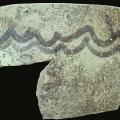
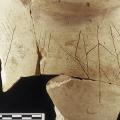
Inscribed storage jar

Many large storage jars of the Harappa Phase (2600-1900 BCE) have writing inscribed along the upper portion of the vessel. This inscription includes a figure of a man with the bow and arrow sign in each hand. It is impossible to shoot two bows and a… >

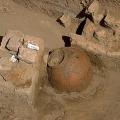
Large jar set into the floor of one of the small rooms, Harappa

Detail of domestic structures with hearths and large jars set into the floor (Trench 41 NE). >

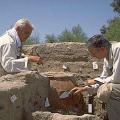
J. Mark Kenoyer and Richard Meadow

HARP co-directors J. Mark Kenoyer and Richard Meadow discuss the excavation of a Kot Diji phase storage jar that was later covered by a hearth. >

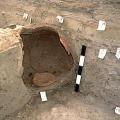
Fill of Kot Diji phase storage jar

Careful excavation of the contents of the Kot Diji phase storage jar revealed a treasure of garbage that can tell us about the food the Kot Dijian people ate and discarded. >

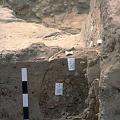
Kot Diji Charcoal Dating

At the bottom of the Kot Diji phase storage vessel was a broken lid and charcoal that was used for dating the fill inside the pot. There is a 91 percent chance that the date obtained from this charcoal falls between 2602 and 2445 radiocarbon years B… >

Storage jar from NB Tr. II

Storage jar from NB Tr. II. >

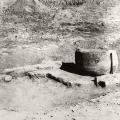
Harappa Platform with large jar

Harappa Platform with large jar in square 2 x 12 in southern portion of Trench A (e). The jar is broken at the top. "2 x 17" is painted on the surface, and this number possibly denotes area of find. Notably, Sahni mentioned a large jar in the … >

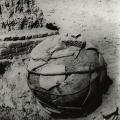
Earthen Jar Trench A (e) from East

A globular jar; tied with a rope to keep the sherds in place. >

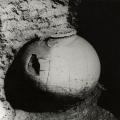
Large Embedded Jar Harappa

Large Jar embedded in the south site of a small wall in front of a tiny cell near wall No. 17 in A (b). Photograph of a jar insitu. Sahni excavated a long Trench A in Mound F, which Vats reported in detail: “In order to trace some… >

© Harappa.com 1995-2026 31