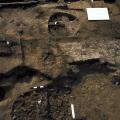
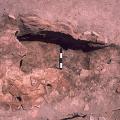
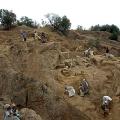
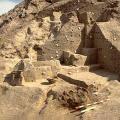
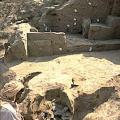
In what appears to have been an alley way between two blocks of buildings in Trench 54 was found a large pit filled with debris from pottery kilns. In the background is a room with a circular pit dug into it. >
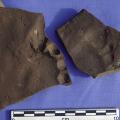
Flat, uneven, pottery discs used as baffles in the firing process were found in the pit with kiln debris from Trench 54 (slide 12). Two of these, broken during the firing of the kiln, bear the foot prints of small children. Pottery manufacture durin… >
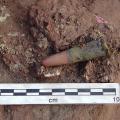
Part of a terra cotta kiln setter found in the Trench 54 South workshop debris. The tip is not vitrified and may have been buried in ash during the firing process. >
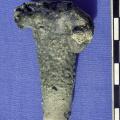
A glazed terra cotta kiln setter with bone fused onto the splayed surface appears to have been an important part of the firing process in the Trench 54 South faience workshop. >
Period 4 (Late Harappan transitional) kiln with hollow lower fire box and arched floor with holes for allowing heat to enter the upper firing chamber. This type of kiln was introduced at Harappa ca. 1900 BC and allowed the potters to reach higher te… >
Looking into the hollow fire box of the Period 4 kiln with arched floor (see image 62). The column of soil in the center was left for support of the floor (Trench 43). >
Harappa Mound AB, Trench 39N, showing the Kot Diji phase (Period 2, ca. 2800-2600 BC) and later levels during excavation. The surveying tripod is standing next to two Kot Diji phase kilns, and the rod is leaning against a later Harappa phase baked b… >
Excavations in 1996 revealed two Period 2 small kilns for making figurines and bangles, as well as preserved floors with Kot Diji style pottery, beads, and figurines >