Slides by Richard H. Meadow, Project Director of HARP (Harappa Archaeological Research Project). His excavations focus on the ancient Indus Valley sites in Pakistan including Balakot near Karachi, Mehrgarh in Baluchistan, and Harappa since 1995.
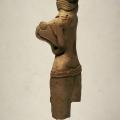
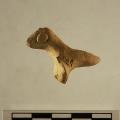
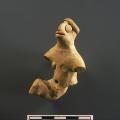
The female figurine usually holds the infant's head to her breast with one or both arms encircling the infant. Approximate dimensions (W x H x D): 3.2 x 8.4 x 1.9 cm. >
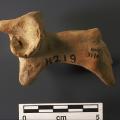
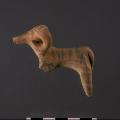
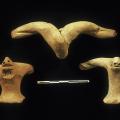
Ram figurines are identified by their large curled horns. Some have incised horns and/or muzzles like the water buffalo figurines and are only distinguished by the curvature of the horns. Approximate height (length): 6.0 cm. >
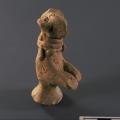
The somewhat schematic "begging dog" figurine on a circular base holds its front paws in front of its body, a posture that is commonly associated with dogs. The figurine wears an elaborate collar that is decorated with applied discs that may represe… >
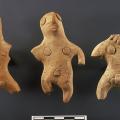
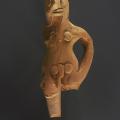
Male figurines may be distinguished by genitalia and/or small flat nipples. A few male figurines wear chokers with pendants very similar to those worn by females. Some males are depicted with bowed legs. Approximate dimensions (W x H x D) of the … >
The ram figurines are also sometimes decorated with black stripes and patterns. Some may be painted black. Occasionally, incised "wool" is depicted on the bodies of sheep figurines. Approximate dimensions (W x H(L) x D): 3.3 x 6.6 x 6.3 cm. >
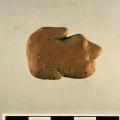
Dogs are also depicted in playful postures, such as one small dog that seems to be crouching with its tail curving up and onto its back. Approximate dimensions (W x H (L) x D): 1.9 x 3.3 x 2.1 cm. >
Other male figurines stand with their hands on their hips and their legs pressed together, a common posture for female figurines. Approximate dimensions (W x H x D): 4.0 x 9.7 x 2.8 cm. >
In addition to domestic animals, wild animals such as the markhor (wild goat) are represented in the corpus of Indus figurines. The markhor figurines’ distinctive long spiral horns were formed by wrapping the clay around a stick or rod while it was … >
Several types of birds are represented in figurines. Bird figurines with long tapered tails probably represent parakeets. These birds often have flattened stylized feet that were attached to other terracotta objects such as cages of which there are … >
A few male figurines demonstrate unusual postures such as one with one leg extended forward and the other extended behind. Male figurines also sometimes wear a simple headband around the top of the head. Approximate dimensions (W x H x D): 4.3 x… >