Home

Main navigation

  • home
  • slides
  • essays
  • articles
  • books
  • video
  • q & a
  • blog
Secondary menu
  • about us
    • scholars
    • privacy
    • support
    • image rights
    • credits
    • contact us
  • resources

Sir John Marshall was a prominent British archaeologist and scholar who focused on the archaeology India and the Indus Valley site - Mohenjo-daro.

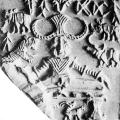
Male god, the prototype of the historic Siva

[Original 1931 text] "There appears at Mohenjo-daro a male god, who is recognizable at once as a prototype of the historic Siva. He is strikingly portrayed on the roughly carved seal [above], which has recently been brought to light by Mr. Mackay." … >

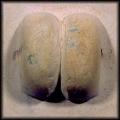
Boss

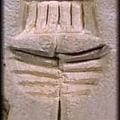
Mackay writes that most of the bosses on the backs of seals had the same size and shape. The perforation always runs in the direction of the animal's body, to help keep the seal upright when worn around the neck. The boss is centered on the back … >

Pottery

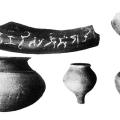
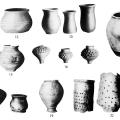
Photographed between 1922-27 and published in Sir John Marshall, Mohenjodaro and The Indus Civilization (1931). >

The Unicorn

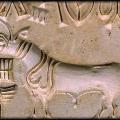
If the figure does represent a cattle species, the clearly carved collar, garland and necklace could help explain its function. Sacrificial animals in village India are often garlanded and decorated similarly today. The Rg Veda speaks of the capture… >

Pottery

[Original 1931 text] "The ancient pottery of Mohenjo-daro frequently has sand or ime, or both, mixed with the clay, more often in the painted ware than in the plain ware. There seems to have been a natural admixture of sand in the alluvial clays use… >

Trough

The unicorn always has this object in front of it. There are at least five theories about this object. Mackay and Marshall thought it was the feeding trough or "manger" still seen in Sindh today. There is work connecting it to contemporary offering … >

The So-called Unicorn

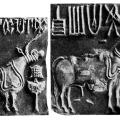
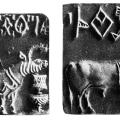
[Original text] "The animal most often represented on the seals is the apparently single-horned beast . . .. There is a possibility, I think, that the artist intended to represent one horn behind the other. In other animals, however, the two horns a… >

Sealing

One of the longer inscriptions made from a seal found during Mackay's excavations between 1927-1931 in Mohenjo-daro (D.K. 9134). There are few long Indus inscriptions; another similarly long inscription was recently found on a wooden signboard in Dh… >

The So-called Unicorn

[Original text, 1931] It should, however, be borne in mind that these animals may perhaps represent the dieties of provinces, in exactly the same way as do the 'nome' animals of Egypt, all of which are commonly shown on standards very similar to the… >

Terminal Signs

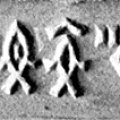
These are the five most common terminal signs on the Indus Valley seals according to Iravatham Mahadevan's analysis (1982:316). The first sign (from the left), the most common in the Indus script (10% of all known signs), is read by him as denoti… >

Pagination

  • Page 1
  • Page 2
  • Page 3
  • Page 4
  • Next page
  • Last page
© Harappa.com 1995-2026 31