
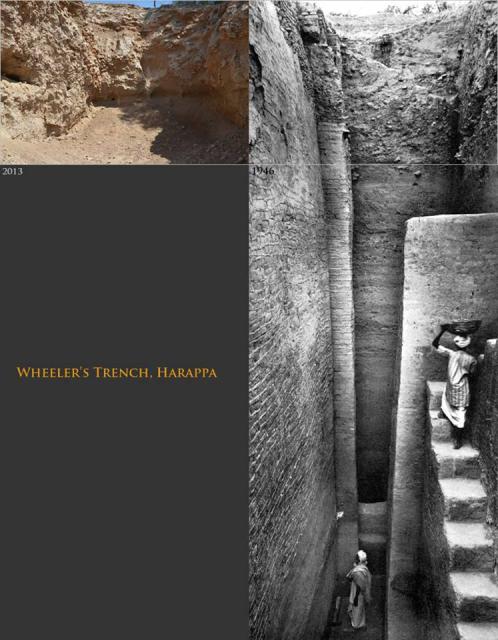
Sir Mortimer Wheeler's famous trench at Harappa in 1946 and today, when it has been filled in once again. Wheeler writes of the incision he orchestrated: "The monsoon-cutting was filled with mud-bricks, which were carried up in bricks and mud to form an anti-flood 'bolster'' or bund, spreading protectively beyond the outer foot of a great defensive wall 45 feet wide at the base and tapering upwards. The main bulk of the wall was of mud-brick but there was an external revetment of baked brick four feet wide as preserved. The back of the mud-brick wall was at first vertical, but insecurity quickly developed, and a slope or batter was introduced during the work. Although structurally secondary, the internal platform was contemporary with the defenses. On it were not less than six distinct phases of baked-brick building, mostly representing changes of plan, and it may be supposed a very considerable stretch of time." (Wheeler, Civilizations of the Indus Valley and Beyond, p. 29-30).
Was the wall constructed for defenses against flooding, or foes, or both?